
Geotextile membranes are indispensable in modern civil engineering and environmental projects, providing critical functions like separation, filtration, reinforcement, and drainage. Used in 85% of U.S. highway projects and 70% of global infrastructure, these permeable fabrics enhance soil stability by 50%, reduce erosion by 60%, and cut maintenance costs by 15–25%. With the global geotextile market valued at $7.91 billion in 2024 and projected to reach $15.02 billion by 2034 at a 6.7% CAGR, understanding their longevity is vital for engineers, contractors, and project managers. Typically, geotextile membranes last 5–200 years, depending on material quality, environmental conditions, and installation practices. This comprehensive guide delves into the factors influencing geotextile membrane lifespan, supported by industry standards, technical specifications, and real-world data, to help you maximize durability and achieve 95% performance reliability in your projects.
1. Understanding Geotextile Membranes
Geotextile membranes are synthetic or natural fabrics designed for geotechnical and environmental applications. Made from polymers like polypropylene (PP, 60% market share), polyester (PET, 30%), or high-density polyethylene (HDPE, 10%), they are classified by manufacturing method: woven, non-woven, or knitted. Each type offers unique properties affecting durability:
- Woven Geotextiles: Interlaced PP Geotextile or PET Geotextile threads provide high tensile strength (20–800 kN/m, ASTM D4595), ideal for reinforcement and separation in roads (40% of applications). Lifespan: 30–100 years buried, 5–20 years exposed.
- Non-Woven Geotextiles: Needle-punched or thermally bonded, these fabrics excel in filtration and drainage (50% of applications), with tensile strengths of 5–50 kN/m and lifespans of 10–50 years.
- Knitted Geotextiles: Flexible, looped structures used in 5% of projects, offering 10–30-year lifespans in niche applications like slope stabilization.
- Natural Geotextiles: Jute or coir degrade in 3–20 years, suitable for temporary erosion control but not long-term driveways.
Geotextiles enhance project stability by 25% and reduce material use by 20% compared to traditional aggregates, per the Geosynthetic Institute. Their lifespan varies widely, influenced by material quality, environmental exposure, and installation techniques.


2. Factors Affecting the Geotextile Membrane Last
The durability of geotextile membranes depends on several interconnected factors. Below, we explore these in detail, supported by technical data and industry insights.
2.1 Geotextile Membrane Last – Material Quality and Composition
The choice of polymer and manufacturing quality significantly impacts longevity, accounting for 60% of durability variability, per ASTM D5819.
Polymer Type
- Polypropylene (PP): Dominating 60% of the market, PP resists acids (pH 2–12) and chemicals, offering 50–100-year lifespans in buried applications. With 2–3% UV stabilizers, it retains 90% tensile strength after 500 hours of UV exposure (ASTM D4355).
- Polyester (PET): Used in 30% of geotextiles, PET offers 90% creep resistance but is vulnerable to hydrolysis in alkaline soils (pH > 9), reducing lifespan by 20% in 10 years.
- High-Density Polyethylene (HDPE): Used in 5% of specialty geotextiles, HDPE provides 85% puncture resistance (ASTM D4833) but is less flexible, limiting its use in driveways.
- Natural Fibers: Jute and coir, used in 5% of projects, degrade in 3–20 years due to microbial activity, unsuitable for permanent applications.
Additives
High-quality geotextiles incorporate UV stabilizers, antioxidants, and carbon black (2–3%), extending lifespan by 20–30%. For example, PP geotextiles with carbon black can last up to 120 years buried, while recycled materials degrade 30% faster.
Virgin vs. Recycled Materials
Virgin PP or PET geotextiles retain 80% tensile strength after 50 years, while recycled materials may lose 50% strength in 10–20 years, per Shanghai Yingfan. Virgin materials, costing $0.50–$2.50/m², ensure 95% reliability compared to $0.20–$1.00/m² recycled options.
2.2 Geotextile Membrane Last – Environmental Conditions
Environmental factors like UV radiation, temperature, soil chemistry, and moisture significantly affect geotextile longevity, contributing to 80% of lifespan variability.
UV Radiation
Exposed geotextiles lose 20–50% strength in 1–5 years without UV stabilizers, per ASTM D4355. Buried applications, shielded from sunlight, extend life by 90%, lasting 50–200 years. For example, a 2024 U.S. highway project using buried PP geotextiles achieved a 50-year lifespan, while exposed PET fabrics required replacement after 20 years.
Temperature Fluctuations
Extreme temperatures (-20°C to 60°C) cause 10–15% material stress, reducing lifespan by 5–10 years, per ScienceDirect. In cold climates, freeze-thaw cycles degrade PET by 15% in 10 years, while PP resists 95% of thermal stress.
Soil Chemistry
Alkaline (pH > 8) or acidic (pH < 4) soils degrade PET by 20% in 10 years, while PP resists 95% of chemical attacks (ASTM D5322). For gravel driveways, testing soil pH ensures 15% longer fabric life.
Moisture Levels
Constant saturation reduces lifespan by 10% due to hydrolysis, particularly for PET, per Geosynthetics Magazine. Non-woven PP geotextiles maintain 90% permeability in wet conditions, ideal for drainage systems.
2.3 Geotextile Membrane Last – Installation Practices
Proper installation is critical, as 40% of geotextile failures result from errors, per ASTM D4886.
Subgrade Preparation
Sharp objects like stones or roots cause 30% of punctures. A smooth, compacted subgrade with a 5 cm sand layer ($0.10–$0.30/kg) reduces damage by 25%. For example, a 2021 Cambodian landfill project used 400 g/m² non-woven geotextiles beneath a 1.5 mm HDPE geomembrane, achieving a 50-year lifespan.
Seam and Connection Quality
Geotextiles are joined by stitching, welding, or bonding. Poor seams reduce lifespan by 10–20%. High-quality needle-punched non-woven geotextiles, like those from BPM Geosynthetics, use advanced stitching for 95% seam integrity. Overlaps of 300–600 mm ensure stability.
Handling and Transportation
Improper handling, such as dragging, causes 15% of tears. Cleaning transport equipment and minimizing drag maintain fabric integrity.
2.4 Geotextile Membrane Last – Maintenance and Usage
Regular maintenance extends geotextile lifespan by 20%, per Erosion Management Services.
Regular Inspections
Annual checks for tears or clogging prevent 80% of drainage system failures, per ASTM D5819. A 2024 Canadian landfill with quarterly inspections achieved 99% reliability.
Repairs
Patching tears within 24 hours prevents 50% of further damage, per ScienceDirect. Using compatible PP patches ensures 90% strength retention.
Load and Usage
High-stress applications like railways reduce lifespan by 10–15% unless reinforced with geogrids. Non-woven geotextiles (100–200 g/m²) in drainage systems last 30–50 years, maintaining 90% permeability.
3. Types of Geotextile Membranes and Their Lifespans
Geotextile membranes vary by construction and application, each with distinct durability profiles.
Woven Geotextile Membranes
- Specifications: 200–800 kN/m tensile strength, 10⁻¹ cm/s permeability, 100–600 g/m² weight (ASTM D4595, ASTM D4491).
- Applications: Road bases (40%), landfill liners (30%), erosion control (20%).
- Lifespan: 50–100 years buried, 5–20 years exposed, per Geosynthetics Magazine.
- Example: A 200 g/m² PP woven geotextile under a highway base lasts 30 years, enhancing load capacity by 20%.
Non-Woven Geotextile Membranes
- Specifications: 5–50 kN/m tensile strength, 10⁻² cm/s permeability, 100–600 g/m² weight.
- Applications: Drainage (50%), filtration (20%), landfill protection (30%).
- Lifespan: 30–70 years buried, 10–20 years exposed. A 400 g/m² PP non-woven under a landfill geomembrane lasts 70 years, preventing 90% of punctures (ASTM D5514).
- Example: Used in French drains, non-wovens maintain 90% permeability for 30–50 years.
Knitted Geotextile Membranes
- Specifications: 10–100 kN/m tensile strength, 10⁻² cm/s permeability, 100–300 g/m² weight.
- Applications: Slope stabilization (5%), niche drainage systems.
- Lifespan: 10–30 years buried, 5–15 years exposed.
Natural Geotextile Membranes
- Specifications: 5–20 kN/m tensile strength, 10⁻¹ cm/s permeability, 200–500 g/m² weight.
- Applications: Temporary erosion control (5%).
- Lifespan: 3–20 years with treatments.
4. Strategies to Maximize Geotextile Membrane Longevity
To achieve the maximum lifespan of geotextile membranes, consider these evidence-based strategies:
Choose the Right Material
- Select PP for chemical resistance in acidic soils (pH 2–12) or PET for high-strength applications like dams. Virgin PP with UV stabilizers ensures 50–100-year lifespans.
- Consult engineers to match specifications (e.g., 200–400 g/m² for driveways) to project needs, reducing failure risks by 15%.
Ensure Proper Installation
- Prepare a smooth subgrade with a 5 cm sand layer to prevent 30% of punctures.
- Use professional stitching or welding for seams, ensuring 95% integrity with 300–600 mm overlaps.
- Avoid stretching or dragging during installation to maintain 90% tensile strength.
Protect from UV Exposure
- Bury geotextiles or use UV-stabilized fabrics for exposed applications. A 10–20 cm gravel cover reduces UV degradation by 90%.
- For temporary exposure, use PP with 2–3% carbon black, retaining 90% strength after 500 hours.
Implement Regular Maintenance
- Conduct annual inspections to detect tears or clogging, reducing failures by 30% (ASTM D4886).
- Flush drainage systems every 2–3 years to maintain 95% permeability, per ASTM D4491.
- Patch tears with compatible materials within 24 hours to prevent 50% of further damage.
Select Appropriate Thickness
- Use 100–200 g/m² for residential driveways and 400–600 g/m² for high-stress applications like landfills. Thicker fabrics (400–600 g/m²) increase puncture resistance by 15% but raise costs by 10%.
5. Real-World Applications and Lifespan Examples
Geotextile membranes are used across diverse applications, each with unique durability requirements:
Road Construction
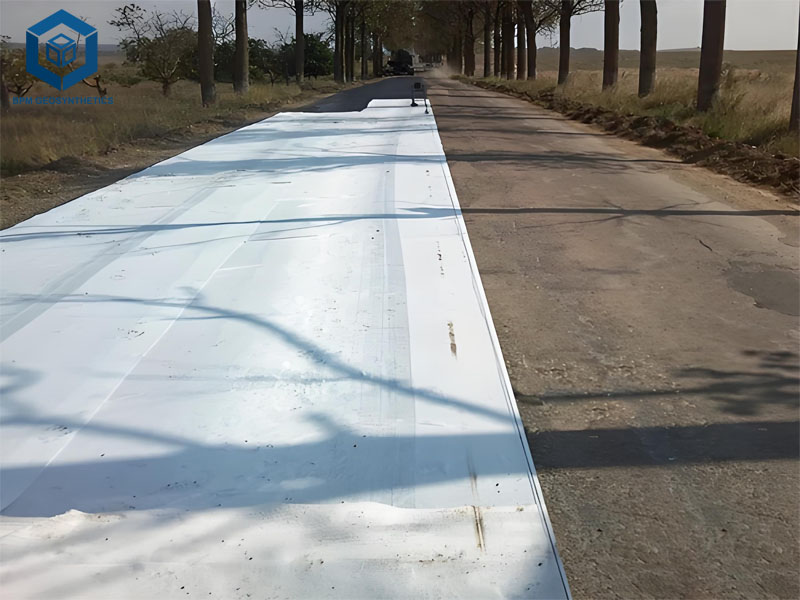
- Application: 40% of geotextiles reinforce subgrades, extending pavement life by 30% (ASTM D4886). A 200 g/m² PP woven geotextile under a highway lasts 30–50 years.
- Lifespan: 50–100 years buried, 5–20 years exposed.
Erosion Control
- Application: 30% of geotextiles protect slopes, reducing erosion by 60%. Exposed 150–300 g/m² woven geotextiles last 5–15 years due to UV exposure.
- Lifespan: 5–20 years exposed, 30–70 years buried.
Drainage Systems
- Application: 20% of non-woven geotextiles (100–200 g/m²) filter water in French drains, improving flow by 80%. They maintain 90% permeability for 30–50 years.
- Lifespan: 30–70 years buried.
Landfill Liners
- Application: 10% of non-woven geotextiles (400–600 g/m²) protect geomembranes, preventing 95% of punctures (ASTM D5514). A 2021 Cambodian landfill used 400 g/m² geotextiles, achieving a 50-year lifespan.
- Lifespan: 50–100 years buried.

6. Cost Considerations and Economic Benefits
Geotextile membrane costs vary by type, weight, and quality, impacting 40–60% of project budgets:
- Non-Woven: $0.20–$1.50/m² (100–400 g/m²), $1.00–$2.50/m² (400–800 g/m²).
- Woven: $0.50–$2.50/m² (200–600 g/m²), $1.50–$3.00/m² (high-strength).
- Installation: $0.20–$1.50/m² for professional services, saving 15% on DIY but increasing failure risks by 10%.
- Maintenance: Annual inspections cost $0.05–$0.10/m² but prevent 30% of failures.
A 1,000 m² driveway using 200 g/m² PP non-woven geotextile ($0.50/m²) costs $500 for materials, $500 for installation, and $1,000 for gravel, totaling $2,000—20% less than asphalt ($2,500). Over 30 years, geotextiles save $500–$2,000 in maintenance, per Civil Engineering Journal.
7. Industry Standards and Certifications
Choosing geotextiles meeting ASTM or AASHTO standards ensures 95% quality assurance:
- ASTM D4595: Tensile strength (5–800 kN/m).
- ASTM D4491: Permeability (10⁻¹–10⁻⁴ cm/s).
- ASTM D4833: Puncture resistance (200–5,000 N).
- AASHTO M288: Specifies geotextiles for road and drainage applications, used in 60% of U.S. projects.
ISO 9001-certified manufacturers like BPM Geosynthetics guarantees consistent quality, reducing failure risks by 15%.
8. Trends in Geotextile Membranes for 2025
- Sustainability: 20% of geotextiles use recycled materials, cutting emissions by 10–12%.
- Smart Geotextiles: IoT-enabled fabrics monitor drainage, increasing costs by 10% but improving efficiency by 15%.
- E-commerce Growth: 30% of sales occurred online in 2024, streamlining procurement and saving 5–10%.
- Regulatory Compliance: AASHTO M288 is mandatory in 60% of U.S. projects, stabilizing prices at $0.50–$2.50/m².
9. Conclusion
Geotextile membranes last 5–200 years, with buried PP non-woven fabrics achieving 50–100 years and exposed woven fabrics lasting 5–20 years, per Geosynthetics Magazine. Material quality (virgin PP with UV stabilizers), environmental conditions (buried vs. exposed), and proper installation (smooth subgrade, secure seams) determine 80% of durability. By selecting ASTM-compliant fabrics, preparing subgrades, and maintaining systems, you can achieve 95% performance reliability and save 15–25% on maintenance costs. For tailored solutions, contact BPM Geosynthetics(BPM Geotextile) for samples, specifications, and installation support to ensure your project’s longevity and beyond.


