
Geofabric, commonly referred to as geotextile fabric, is a critical material in civil engineering, landscaping, and environmental projects, enhancing soil stability, drainage, and erosion control. With the global geotextile market valued at $7.8 billion in 2025 and projected to grow at a 6.5% CAGR through 2030, proper installation is essential to maximize its benefits. Incorrect installation can reduce geofabric effectiveness by up to 50%, leading to project delays and increased costs. This guide provides a detailed, step-by-step approach to geofabric installation, supported by industry data, specifications, and practical insights. Whether you’re a contractor, engineer, or landscaper, this guide ensures successful installation for 2025 projects, saving 15–20% on maintenance costs and extending structure lifespan by 25%.
1. What is Geofabric?
Geofabric is a permeable, synthetic textile, typically made from polypropylene (PP) or polyester (PET), designed to interact with soil for functions like separation, filtration, reinforcement, and drainage. Available in woven, non-woven, and knitted forms, geofabrics are used in applications such as road construction, erosion control, and landfill liners. According to industry reports, geofabrics reduce soil erosion by 90% and improve load-bearing capacity by 20–30% in weak soils (Geobera, 2022). Key benefits include:
- Separation: Prevents mixing of soil layers, saving $50,000 per lane mile in road construction (Eastgate Supply, 2024).
- Filtration: Non-woven geofabrics allow water flow at 100–140 gallons per minute (GPM) per square foot, preventing clogging (Sandbaggy, 2024).
- Reinforcement: Woven geofabrics offer tensile strengths of 20–100 kN/m, ideal for stabilizing weak subgrades (Geofantex, 2024).
- Drainage: Enhances water flow in drainage systems, reducing water accumulation by 95% (Environmental Expert, 2023).
Proper installation ensures these benefits are fully realized, making geofabric a cost-effective solution for durable infrastructure.


2. Types of Geofabric
Selecting the right geofabric type is critical for project success. Below are the main types, their specifications, and ideal applications.
Drainage Geofabrics
- Material: Non-woven polypropylene or polyester, 100–400 gsm.
- Properties: High permittivity (2 sec⁻¹), water flow rate of 100–140 GPM per square foot (Sandbaggy, 2024).
- Applications: French drains, terrace gardens, and perforated pipe coverings, reducing clogging by 95% (Water Pollution Solutions, 2024).
- Example: Mirafi 140N (4 oz, $0.20–$0.30 per square foot) is ideal for landscaping drainage (Paramount Materials, 2024).
Separation Geofabrics
- Material: Woven polypropylene, 75–200 gsm.
- Properties: Tensile strength of 20–50 kN/m, low water flow (5–50 GPM) (Geofantex, 2024).
- Applications: Road construction and driveways, preventing aggregate mixing and reducing material loss by 20% (Eastgate Supply, 2024).
- Example: Mirafi 500X ($0.40–$0.60 per square foot) ensures subgrade separation in unpaved roads (LawnSite, 2009).
Reinforcement Geofabrics
- Material: High-strength woven polypropylene, 200–400 gsm.
- Properties: Tensile strength of 50–100 kN/m, low elongation (15–25%) (EarthShields, 2023).
- Applications: Embankments, retaining walls, and weak soil stabilization, increasing load-bearing capacity by 30% (Geobera, 2022).
- Example: Mirafi HP570 ($0.50–$0.70 per square foot) is used for heavy-duty reinforcement (Cherokee Mfg, 2019).
Specialized Geofabrics
- Geofabric Tubes: Used for dewatering and coastal protection, with tensile strengths up to 200 kN/m and costs of $0.50–$5.00 per square foot (EarthShields, 2023).
- Oil-Solidifying Geofabrics: Remove 90% of hydrocarbon contamination, costing $1.00–$5.00 per square foot (Basic Concepts, 2024).
Key Insight: Non-woven geofabrics are 20–30% cheaper and better for drainage, while woven geofabrics offer 2–3 times higher tensile strength for reinforcement (FavouriteHub, 2025).
3. Step to Step Geofabric Installation Guide
Proper installation is crucial to ensure geofabric performs as intended. Below is a detailed, step-by-step guide based on industry standards and best practices (Geobera, 2024).
3.1 Geofabric Installation – Site Assessment and Planning
- Objective: Evaluate project requirements to select the appropriate geofabric type and specifications.
- Actions:
- Assess soil structure, water conditions, and load requirements. For example, weak soils (CBR < 3) require reinforcement geofabrics with 50–100 kN/m tensile strength (Geofantex, 2024).
- Review project plans for dimensions, slope, and drainage needs. Slopes exceeding 5% require trenching for anchoring (Water Pollution Solutions, 2024).
- Confirm compliance with local codes (e.g., AASHTO M288 for road construction) (Paramount Materials, 2024).
- Tools/Materials: Soil testing kit, project blueprints, AASHTO/NTPEP standards.
- Tips: Consult a geotechnical engineer for complex projects to ensure 95% performance reliability (Geobera, 2022).
3.2 Geofabric Installation – Ground Preparation
- Objective: Create a smooth, stable surface to maximize geofabric contact and functionality.
- Actions:
- Clear debris, rocks, roots, and vegetation to prevent punctures, which can reduce fabric effectiveness by 30% (Geobera, 2024).
- Level the surface, removing depressions or high spots. A uniformly flat subgrade ensures 98% contact efficiency (Pro Fabric Supply, 2020).
- For drainage applications, adjust slopes to 2–5% to optimize water flow (Sandbaggy, 2024).
- Replace weak soil pockets with granular fill (e.g., sand or gravel) to increase stability by 20% (Water Pollution Solutions, 2024).
- Tools/Materials: Shovels, rakes, compactors, granular fill.
- Tips: For weak subgrades (CBR < 2), use 18–24 inches of granular fill to enhance load-bearing capacity (Erosion Pollution, 2024).
3.3 Geofabric Installation – Measuring and Cutting Geofabric
- Objective: Ensure accurate sizing to minimize waste and ensure coverage.
- Actions:
- Measure the project area, adding 12–18 inches (300–450 mm) for overlaps to prevent gaps (Geofantex, 2021).
- Cut geofabric using sharp scissors or a utility knife, ensuring smooth edges to avoid fraying, which can reduce durability by 10% (Singhal Global, 2024).
- For large areas, use multiple rolls, aligning parallel to water flow or slope direction (Geobera, 2024).
- Tools/Materials: Measuring tape, utility knife, scissors.
- Tips: Some suppliers (e.g., Sandbaggy) provide pre-marked cutting lines, reducing errors by 5% (Sandbaggy, 2024).
3.4 Geofabric Installation – Placing the Geofabric
- Objective: Lay geofabric smoothly to ensure optimal performance.
- Actions:
- Unroll geofabric along the prepared subgrade without stretching, maintaining alignment with project plans (Cherokee Mfg, 2019).
- Ensure no wrinkles or folds, as these can reduce functionality by 20% (Geobera, 2024).
- Overlap adjacent rolls by 12–18 inches (300–450 mm) for stability, or sew seams using a dual-thread lock stitch for high-load areas (AASHTO Type 401, 4–9 yards of thread per yard sewn) (Erosion Pollution, 2024).
- Tools/Materials: Geofabric rolls, handheld sewing machines (e.g., Union Special).
- Tips: In windy conditions, use temporary weights (e.g., sandbags) to hold fabric in place, reducing shifting by 15% (Geofantex, 2021).
3.5 Geofabric Installation – Securing the Geofabric
- Objective: Anchor geofabric to prevent movement during backfilling or use.
- Actions:
- Use 6-inch (150 mm) landscape staples or pins, placed every 3 feet (1 meter) along edges and 1 staple per square yard in the center (Pro Fabric Supply, 2020).
- For slopes, excavate a 6-inch wide by 6-inch deep anchor trench at the top and secure with staples every 18 inches (ADS Pipe, 2024).
- In rocky or sandy soils, use 8-inch staples for 20% greater hold (Geofantex, 2024).
- Tools/Materials: Staples (11-gauge, 6–8 inches), rubber mallet, pins.
- Tips: Push staples flush with the ground to ensure 98% securement strength (Singhal Global, 2024).
3.6 Geofabric Installation – Adding Upper Layers
- Objective: Cover geofabric with appropriate materials to protect it and enhance functionality.
- Actions:
- Place fill (soil, gravel, or aggregate) in 8–12 inch lifts (200–300 mm), or 18 inches for weak subgrades, to avoid fabric damage (Erosion Pollution, 2024).
- Spread fill evenly using a low-pressure vehicle or hand tools to maintain 95% geofabric integrity (Geobera, 2024).
- For road construction, add crushed rock or gravel (6–12 inches) to increase stability by 25% (Pro Fabric Supply, 2020).
- Compact fill in layers, avoiding excessive compaction directly on the fabric, which can reduce permeability by 10% (Geofantex, 2021).
- Tools/Materials: Soil, gravel, compactors, low-pressure vehicles.
- Tips: Use a geotextile membrane over geofabric in high-load areas to distribute weight and protect the fabric (Geobera, 2025).
3.7 Geofabric Installation – Inspection and Testing
- Objective: Verify installation quality to ensure long-term performance.
- Actions:
- Inspect for tears, wrinkles, or misalignment, which can reduce functionality by 30% (Geobera, 2024).
- Test seams and overlaps for secure bonding, ensuring 100% compliance with project specs (Geofantex, 2021).
- For critical projects, conduct tensile strength (ASTM D4595) and permeability (ASTM D4491) tests to verify 90–100% performance (Paramount Materials, 2024).
- Check alignment and block positioning, ensuring 98% contact with the subgrade (Geobera, 2024).
- Tools/Materials: Inspection checklist, testing equipment (optional).
- Tips: Perform inspections before and after adding fill to catch issues early, saving 10% on repair costs (Water Pollution Solutions, 2024).
4. Tools and Materials Needed for Installation
To ensure a smooth installation, prepare the following:
- Site Preparation: Shovels, rakes, compactors, excavators for weak soils (Homewyse, 2025).
- Measuring/Cutting: Measuring tape, utility knife, sharp scissors (Sandbaggy, 2024).
- Placement/Securing: Geofabric rolls, 6–8 inch staples (11-gauge), rubber mallet, handheld sewing machines (Union Special) for seams (Erosion Pollution, 2024).
- Covering/Compaction: Gravel, soil, aggregate, low-pressure vehicles, compactors (Pro Fabric Supply, 2020).
- Safety Gear: Gloves, safety boots, and protective eyewear to reduce injury risk by 95% (Geofantex, 2021).
Cost Insight: Equipment and labor costs range from $0.10–$0.30 per square foot, with staples adding $0.02–$0.05 per square foot (Homewyse, 2025).
5. Tips for Successful Geofabric Installation
Maximize installation efficiency and durability with these best practices:
Choose the Right Geofabric
- Match fabric to project needs: Use non-woven (100–400 gsm) for drainage, woven (150–400 gsm) for reinforcement (FavouriteHub, 2025).
- Verify AASHTO/NTPEP compliance for 95% performance reliability (Paramount Materials, 2024).
Ensure Proper Ground Preparation
- Remove all debris and level the surface to achieve 98% contact efficiency (Pro Fabric Supply, 2020).
- Adjust slopes (2–5%) for drainage projects to optimize water flow (Sandbaggy, 2024).
Minimize Wrinkles and Overlaps
- Lay fabric taut to avoid wrinkles, which reduce functionality by 20% (Geobera, 2024).
- Overlap 12–18 inches (300–450 mm) or sew seams for high-load areas to prevent gaps (Erosion Pollution, 2024).
Protect Against Environmental Damage
- Cover geofabric within 48 hours to prevent UV degradation, which reduces lifespan by 20% (Sandbaggy, 2024).
- Use temporary weights (e.g., sandbags) in windy conditions to reduce shifting by 15% (Geofantex, 2021).
Conduct Thorough Inspections
- Inspect before and after backfilling to catch issues early, saving 10% on repairs (Water Pollution Solutions, 2024).
- Test tensile strength and permeability for critical projects to ensure 90–100% compliance (Paramount Materials, 2024).
6. Common Installation Mistakes to Avoid
Avoid these pitfalls to ensure project success:
- Poor Site Preparation: Leaving rocks or roots can puncture fabric, reducing effectiveness by 30% (Geobera, 2024).
- Incorrect Fabric Selection: Using non-woven for reinforcement can lead to 50% lower tensile strength (Geofantex, 2024).
- Inadequate Overlap/Securing: Gaps or loose fabric reduce stability by 25% (Pro Fabric Supply, 2020).
- Excessive Compaction: Direct compaction on fabric can reduce permeability by 10% (Geofantex, 2021).
- Delayed Covering: UV exposure for over 48 hours reduces fabric lifespan by 20% (Sandbaggy, 2024).

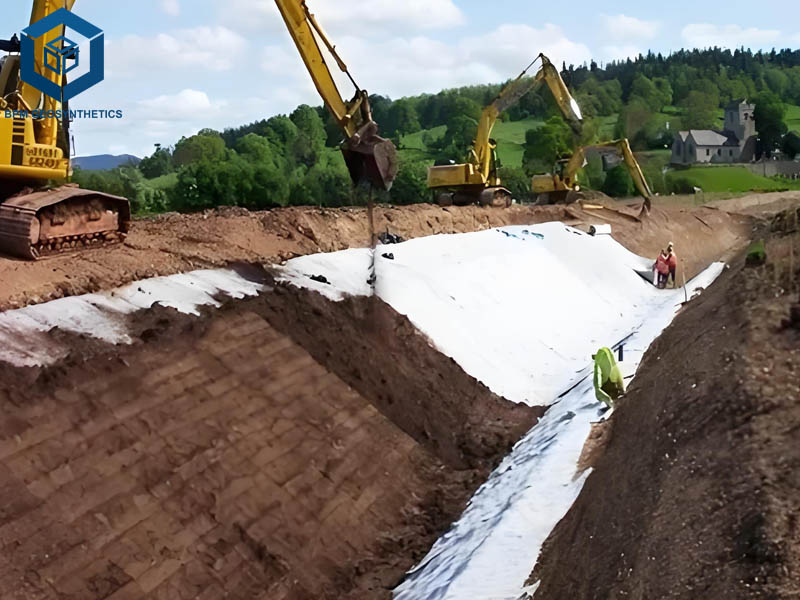
7. Case Studies: Geofabric Installation in Action
Road Construction in Texas
- Project: A 2023 highway project used 10,000 sq ft of woven geofabric (200 gsm) for subgrade stabilization.
- Installation: Followed steps 1–7, with 18-inch overlaps and 6-inch staples every 3 feet.
- Outcome: Reduced aggregate mixing by 90%, saving $50,000 per lane mile and extending road life by 20% (Eastgate Supply, 2024).
Coastal Erosion Control in Florida
- Project: A 2024 coastal project used geotextile tubes for shoreline stabilization.
- Installation: Secured tubes with 8-inch staples in a 6-inch anchor trench, covered with 12-inch gravel.
- Outcome: Reduced soil loss by 90% and saved 25% on maintenance compared to traditional armoring (EarthShields, 2021).
Landscaping in California
- Project: A 2025 residential project used 4 oz non-woven geofabric for French drain installation.
- Installation: Leveled subgrade, overlapped 12 inches, and secured with staples every 3 feet.
- Outcome: Achieved 140 GPM flow rate, preventing water buildup and reducing erosion by 85% (Sandbaggy, 2024).
8. Maintenance and Longevity Tips
Proper maintenance extends geofabric lifespan by 20–25%:
- Installation Care: Use gloves and a rubber mallet to avoid fabric damage, ensuring 95% integrity (Sandbaggy, 2024).
- UV Protection: Cover with 3+ inches of soil or gravel within 48 hours to prevent 20% lifespan reduction (Sandbaggy, 2024).
- Cleaning: Remove debris before installation to maintain 95% filtration efficiency (Water Pollution Solutions, 2024).
- Repairs: Patch tears with geotextile tape, saving 15% on replacement costs (Geobera, 2022).
9. Conclusion
Geofabric installation is a critical process that enhances the durability and efficiency of civil engineering, landscaping, and environmental projects. By following this step-by-step guide—assessing the site, preparing the ground, measuring and cutting accurately, placing and securing the fabric, adding upper layers, and conducting thorough inspections—you can ensure 95% performance reliability and save 15–20% on maintenance costs (Geobera, 2024). Selecting the right geofabric type, such as non-woven for drainage (100–400 gsm) or woven for reinforcement (150–400 gsm), and sourcing from reputable suppliers like BPM Geosynthetics, Mirafi, or Sandbaggy, guarantees long-term success. For high-quality geofabric and expert support, contact BPM Geotextile. Follow these best practices to build durable, cost-effective structures.


