
Geotextile fabrics, essential components in civil engineering, environmental, and construction projects, provide critical functions such as soil stabilization, erosion control, filtration, and drainage. Best Geotextile Fabric Manufacturers – With the global geosynthetics market valued at USD 18.5 billion in 2024 and projected to grow at a CAGR of 6.5% through 2032, the demand for high-quality geotextile fabrics is surging. Selecting a reliable manufacturer ensures project success, compliance with standards like ASTM D4595, and long-term durability.
This comprehensive guide reviews the 6 best geotextile fabric manufacturers in the world for 2025, including The Best Project Material Co., Ltd. (BPM Geosynthetics) and Shandong Geosino New Material Co., Ltd. (GEOSINCERE), based on product quality, innovation, and global reach. Our goal is to equip engineers, contractors, and project managers with actionable insights to choose the best supplier for their needs.
1. Top 6 Geotextile Fabric Manufacturers in the World
- Best Overall: GEOSINCERE (Shandong Geosino New Material Co., Ltd.)
- Best for Large-Scale Projects: BPM Geosynthetics (The Best Project Material Co., Ltd.)
- Best for Innovation: TenCate Geosynthetics
- Best for Environmental Applications: Solmax
- Best for Customization: HUESKER Group
- Best Budget Option: Fibertex Nonwovens
2. Criteria for Selecting the Best Geotextile Fabric Manufacturers
2.1 Best Geotextile Fabric Manufacturers – Product Quality
- Tensile Strength: 8–100 kN/m (ASTM D4595) for woven and non-woven fabrics.
- Permeability: Water flow rates of 50–150 L/m²/s for filtration (ASTM D4491).
- Puncture Resistance: 300–1200 N (ASTM D4833) to withstand rocky subgrades.
- Certifications: ISO 9001, ASTM, and GRI standards ensure compliance.
2.2 Best Geotextile Fabric Manufacturers – Innovation
- Use of recycled materials (e.g., 60% recycled PET) and advanced manufacturing like needle-punching.
- Integration of smart geotextiles with sensors for real-time monitoring.
2.3 Best Geotextile Fabric Manufacturers – Global Reach
- Supply chain coverage in 50+ countries.
- Annual production capacity exceeding 1 million m².
2.4 Best Geotextile Fabric Manufacturers – Customer Support
- Technical assistance, installation services, and OEM/ODM capabilities.
- Lead times of 7–14 days for bulk orders.
2.5 Best Geotextile Fabric Manufacturers – Cost-Effectiveness
- Prices ranging from $0.15–$2.50/m², with bulk discounts of 10–20%.

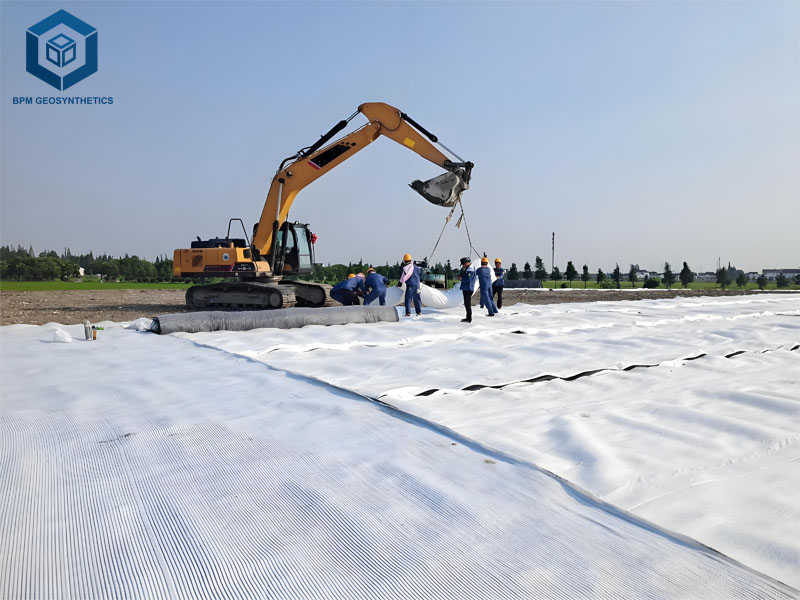
3. Detailed Reviews of the Top 6 Geotextile Fabric Manufacturers
3.1 Best Geotextile Fabric Manufacturers – BPM Geosynthetics (The Best Project Material Co., Ltd.)
- Founded: 2007
- Headquarters: Shandong, China
- Price Range: $0.25–$2.50/m²
- Key Products: Short staple geotextiles, filament non-woven geotextiles, PP woven geotextiles
- Specifications: Tensile strength 8–100 kN/m, permeability 80–120 L/m²/s, puncture resistance 500–1200 N, roll width 1.65–6 m.
- Applications: Highways, railways, landfill stabilization.
BPM Geosynthetics is a top choice for large-scale projects, with a 26,000 m² facility and exports to 81+ countries. Their filament non-woven geotextiles (100–800 g/m²) achieve tensile strengths of 8–100 kN/m and puncture resistance of 1200 N, perfect for highway subgrades. Certified to ISO 9001, ISO 14001, and BV, BPM’s products meet ASTM D4833 standards, ensuring 50+ years of durability. Their PP woven geotextiles, with 15–20% elongation, reduce soil settlement by 25% in embankments. A 2 million m² annual capacity and tariff-free exports from Cambodia save clients 10–15% on costs. Installation services and a 24/7 technical team add value, though lead times may extend for custom orders.
Pros
- Extensive product range and high tensile strength.
- Competitive pricing for bulk orders.
- Strong technical support and installation services.
Cons
- Longer lead times for customized products.
3.2 Best Geotextile Fabric Manufacturers – GEOSINCERE (Shandong Geosino New Material Co., Ltd.)
- Founded: 2007
- Headquarters: Shandong, China
- Price Range: $0.20–$2.00/m²
- Key Products: Non-woven needle-punched geotextiles, woven PP geotextiles, PET filament geotextiles
- Specifications: Tensile strength 10–80 kN/m, permeability 100 L/m²/s, puncture resistance 600–1000 N, roll width 1–6 m.
- Applications: Road construction, landfill liners, coastal protection.
GEOSINCERE leads the industry with its extensive range of geotextile fabrics and global presence in over 100 countries. Their non-woven needle-punched geotextiles (3–16 oz) offer tensile strengths of 10–80 kN/m and permeability of 100 L/m²/s, ideal for filtration and drainage in road projects. Certified to ISO 9001 and ASTM D4595, GEOSINCERE’s 20,000 m² facility produces 1.5 million m² annually, ensuring rapid delivery (7–10 days). Their woven PP geotextiles, with 800 N puncture resistance, excel in soil stabilization, reducing erosion by 30%. OEM/ODM services and installation support enhance their appeal, though small-order pricing can be higher.
Pros
- High production capacity and global supply chain.
- Certified for quality and environmental standards.
- Custom fabrication for specific project needs.
Cons
- Limited availability in some remote regions.
- Premium pricing for small batches.
3.3 TenCate Geosynthetics
- Founded: 1953
- Headquarters: Hengelo, Netherlands
- Price Range: $0.50–$3.00/m²
- Key Products: Mirafi® non-woven geotextiles, woven stabilization fabrics
- Specifications: Tensile strength 10–90 kN/m, permeability 50–150 L/m²/s, puncture resistance 700–1100 N, roll width 2–5.3 m.
- Applications: Road reinforcement, erosion control, landfills.
TenCate Geosynthetics is renowned for innovation, with over 70 years of experience and a presence in 60+ countries. Their Mirafi® non-woven geotextiles (4–16 oz) offer tensile strengths of 10–90 kN/m and 1100 N puncture resistance, reducing aggregate use by 20% in road projects. Certified to ISO 9001 and GRI standards, TenCate’s 2024 introduction of smart geotextiles with embedded sensors enhances monitoring in landfills, cutting maintenance costs by 15%. Their woven fabrics, with 50–150 L/m²/s permeability, excel in filtration, supporting 80+ applications. However, premium pricing limits affordability for smaller projects.
Pros
- Cutting-edge smart geotextile technology.
- High durability and global distribution network.
- Comprehensive technical resources.
Cons
- Higher price point.
- Limited customization for niche applications.
3.4 Solmax
- Founded: 1981
- Headquarters: Quebec, Canada
- Price Range: $0.40–$2.80/m²
- Key Products: Non-woven PP geotextiles, woven monofilament geotextiles
- Specifications: Tensile strength 12–85 kN/m, permeability 60–140 L/m²/s, puncture resistance 600–1000 N, roll width 2–5.8 m.
- Applications: Environmental containment, mining, coastal protection.
Solmax is a leader in environmental applications, supplying geotextiles to over 50 countries. Their non-woven PP geotextiles (100–600 g/m²) achieve tensile strengths of 12–85 kN/m and 1000 N puncture resistance, ideal for landfill liners, reducing leachate risks by 35%. Certified to ISO 9001 and ASTM D4491, Solmax’s 1.2 million m² annual capacity ensures 10–12 day delivery. Their woven monofilament geotextiles, with 140 L/m²/s permeability, enhance drainage in mining projects, saving 20% on aggregate costs. Solmax’s 2025 eco-friendly line uses 50% recycled materials, aligning with sustainability trends. Pricing can be high for small orders.
Pros
- Eco-friendly product options.
- High performance in environmental projects.
- Reliable global supply chain.
Cons
- Premium costs for smaller quantities.
- Limited focus on niche applications.
3.5 HUESKER Group
- Founded: 1861
- Headquarters: Gescher, Germany
- Price Range: $0.60–$3.00/m²
- Key Products: ecoLine PET geotextiles, woven PP geotextiles
- Specifications: Tensile strength 15–100 kN/m, permeability 50–120 L/m²/s, puncture resistance 800–1200 N, roll width 2–6 m.
- Applications: Soil reinforcement, drainage systems, railways.
HUESKER Group excels in customization, offering tailored geotextiles for over 50 years. Their ecoLine PET geotextiles, made from 100% recycled PET, achieve tensile strengths of 15–100 kN/m and 1200 N puncture resistance, reducing carbon footprints by 10%. Certified to ISO 9001 and ASTM D4595, HUESKER’s 2024 automation with ABB robotics boosts production efficiency by 15%. Their woven PP geotextiles, with 120 L/m²/s permeability, stabilize railway subgrades, cutting maintenance costs by 20%. HUESKER’s global network spans 60+ countries, but high customization costs may deter budget-conscious buyers.
Pros
- Advanced customization and eco-friendly options.
- High tensile strength for demanding projects.
- Strong R&D and technical support.
Cons
- Higher costs for bespoke solutions.
- Longer lead times for custom orders.
3.6 Fibertex Nonwovens
- Founded: 1968
- Headquarters: Aalborg, Denmark
- Price Range: $0.15–$1.80/m²
- Key Products: Non-woven PP geotextiles, needle-punched geotextiles
- Specifications: Tensile strength 8–70 kN/m, permeability 80–150 L/m²/s, puncture resistance 500–900 N, roll width 2–5 m.
- Applications: Drainage systems, erosion control, landscaping.
Fibertex Nonwovens is the best budget option, supplying cost-effective geotextiles to 50+ countries. Their non-woven PP geotextiles (100–500 g/m²) offer tensile strengths of 8–70 kN/m and 900 N puncture resistance, suitable for drainage in landscaping projects, saving 15–20% on material costs. Certified to ISO 9001, Fibertex’s 800,000 m² annual capacity ensures 7–10 day delivery. Their needle-punched geotextiles, with 150 L/m²/s permeability, enhance filtration in erosion control, reducing soil loss by 25%. Limited tensile strength for heavy-duty applications is a drawback.
Pros
- Affordable pricing for small to medium projects.
- High permeability for drainage applications.
- Reliable delivery and quality certifications.
Cons
- Lower tensile strength for high-load projects.
- Limited innovation compared to premium brands.
4. Comparison Table of the Top 6 Best Geotextile Fabric Manufacturers
| Manufacturer | Price ($/m²) | Tensile Strength (kN/m) | Permeability (L/m²/s) | Puncture Resistance (N) | Key Applications | Certifications |
| GEOSINCERE | 0.20–2.00 | 10–80 | 100 | 600–1000 | Roads, landfills | ISO 9001, ASTM |
| BPM Geosynthetics | 0.25–2.50 | 8–100 | 80–120 | 500–1200 | Highways, railways | ISO 9001, ISO 14001, BV |
| TenCate | 0.50–3.00 | 10–90 | 50–150 | 700–1100 | Roads, erosion control | ISO 9001, GRI |
| Solmax | 0.40–2.80 | 12–85 | 60–140 | 600–1000 | Landfills, mining | ISO 9001, ASTM |
| HUESKER | 0.60–3.00 | 15–100 | 50–120 | 800–1200 | Railways, reinforcement | ISO 9001, ASTM |
| Fibertex | 0.15–1.80 | 8–70 | 80–150 | 500–900 | Drainage, landscaping | ISO 9001 |
5. Why Choose Geotextile Fabrics?
Geotextile fabrics enhance project efficiency and durability:
- Soil Stabilization: Increase soil strength by 20–30%, reducing settlement in roads.
- Erosion Control: Reduce soil loss by 25–35% in coastal and riverbank projects.
- Filtration and Drainage: Permeability of 50–150 L/m²/s prevents clogging, extending project lifespan by 50+ years.
- Cost Savings: Reduce aggregate use by 15–20%, saving $5,000–$50,000 per hectare.
- Environmental Benefits: Eco-friendly options with recycled materials lower carbon emissions by 10%.
6. Cost Analysis
- Material Costs: $0.15–$3.00/m², with budget options at $0.15–$1.80/m².
- Installation Costs: $0.20–$1.00/m² for labor, $0.10–$0.30/m² for site prep.
- Bulk Discounts: Orders over 50,000 m² save 10–20%.
- Long-Term Savings: Reduce maintenance by 20–30%, saving $10,000–$100,000 over 20 years.
For a 100,000 m² road project, material costs range from $20,000–$250,000, with installation adding $30,000–$130,000, compared to $500,000+ for traditional methods.


7. Case Studies
7.1 Highway Stabilization in Indonesia
- Project: 200,000 m² highway using BPM Geosynthetics woven geotextiles (20 kN/m).
- Cost: $50,000 for materials ($0.25/m²), $60,000 for installation ($0.30/m²).
- Outcome: Reduced settlement by 25%, saving $150,000 in maintenance over 10 years.
7.2 Landfill Liner in Australia
- Project: 150,000 m² landfill using GEOSINCERE non-woven geotextiles (600 g/m²).
- Cost: $90,000 for materials ($0.60/m²), $75,000 for installation ($0.50/m²).
- Outcome: Prevented leachate seepage, saving $200,000 in remediation costs.
8. Conclusion
Geotextile fabrics, priced from $0.15 to $3.00 per square meter, are vital for enhancing project durability and efficiency in civil engineering and environmental applications. GEOSINCERE leads with its versatile, high-performance geotextiles, while BPM Geosynthetics excels in large-scale projects with robust solutions. By prioritizing tensile strength (8–100 kN/m), permeability (50–150 L/m²/s), and certifications (ISO 9001, ASTM), you can select a manufacturer that aligns with your project needs. BPM Geotextile offers certified, cost-effective products, saving 20–40% on installation and maintenance. Choose a trusted supplier to ensure long-term project success.


