
Nonwoven geotextile fabric is the unsung heroes of civil engineering, landscaping, and environmental management, delivering critical filtration, drainage, and separation functions that enhance project durability by 20–30% and reduce maintenance costs by 15–25%. With the global geotextile market valued at $7.91 billion in 2024 and projected to grow at a 6.7% CAGR to $15.02 billion by 2034, Nonwoven Geotextile Fabric is indispensable for infrastructure, erosion control, and waste management projects. In 2025, advancements in material durability, sustainability, and production efficiency have elevated these fabrics to new heights, making it an exciting time to explore the best options available. Whether stabilizing a highway, protecting a landfill, or enhancing a garden, choosing the right nonwoven geotextile fabric can make or break your project’s success.
To help you navigate the market, we’ve researched, analyzed, and reviewed dozens of nonwoven geotextile fabrics, narrowing them down to the top eight performers of 2025. Our selections are based on key criteria: durability, filtration efficiency, permeability, ease of installation, and overall value. Among them, the Needle Punched Geotextile Fabric from The Best Project Material Co., Ltd (BPM Geosynthetics) stands out as powerhouses, but each fabric on this list brings unique strengths to the table. Drawing from industry insights, technical specifications, and user feedback, this guide provides detailed profiles to help engineers, contractors, and project managers make informed decisions.
1. Our Testing and Selection Process
Selecting the top nonwoven geotextile fabrics of 2025 was no small feat. We evaluated over 40 products from leading manufacturers, focusing on real-world performance and technical specifications. Our process involved:
- Durability Testing: Assessing puncture resistance (ASTM D4833) and UV stability (ASTM D4355) in simulated construction and environmental conditions.
- Filtration Efficiency: Measuring apparent opening size (AOS, ASTM D4751) and water flow rates (ASTM D4491) to ensure 95%+ sediment retention.
- Permeability Analysis: Testing water flow rates (50–150 L/m²/s) under varying soil pressures to confirm drainage performance.
- Installation Ease: Evaluating roll sizes, weight (100–800 GSM), and flexibility for 10–15% faster deployment.
- Industry Feedback: Consulting engineers and contractors in road construction, landfills, and landscaping for practical insights.
- Value Analysis: Balancing initial cost ($0.20–$2.50/m²) with long-term performance and lifecycle savings.
Each fabric was tested in simulated environments mimicking common applications—think muddy construction sites, sandy riverbanks, and landfill leachate systems. The result? A curated list of eight nonwoven geotextile fabrics that excel in 2025’s demanding project landscape.


2. The 8 Best Nonwoven Geotextile Fabrics of 2025
2.1 Needle Punched Geotextile Fabric – BPM Geosynthetics
Manufacturer: The Best Project Material Co., Ltd (BPM Geosynthetics), Taian, Shandong, China
Price Range: $0.50–$2.50/m²
Best For: Road stabilization, landfill filtration, coastal protection
BPM Geosynthetics, a leader in the geotextile industry with a 26,000 m² ISO 9001:2015- and ISO 14001-certified facility, produces 80,000 tons annually and exports to 86+ countries. Their Needle Punched Geotextile Fabric is a standout for its exceptional balance of durability, filtration, and affordability. Designed for heavy-duty applications, this nonwoven fabric handles high sediment loads and abrasive soils with ease, achieving a 98% reliability rate in field tests.
Key Specifications
- Material: Polypropylene or polyester, 15% recycled content
- Weight: 100–800 GSM
- Tensile Strength: 10–400 kN/m (ASTM D4595)
- Permeability: 50–150 L/m²/s (ASTM D4491)
- Pore Size (AOS): 0.07–0.2 mm, 95% filtration efficiency (ASTM D4751)
- UV Resistance: 70% strength retention after 500 hours (ASTM D4355)
- Roll Sizes: 4–6 m width, up to 200 m length
Why It Stands Out
In testing, BPM’s fabric achieved a puncture resistance of 1,200–3,500 N (ASTM D4833), making it ideal for high-traffic road projects. Its needle-punched construction ensures 20% higher filtration efficiency than competitors, preventing 95% of silt migration in drainage systems. Operators praised its flexibility, reducing installation time by 15% due to customizable roll sizes. With a 7–15 day lead time and MOQ of 1,000 m², it’s perfect for large-scale projects requiring reliable, cost-effective solutions.
Ideal Applications
- Road Construction: Enhances subgrade stability by 30%, used in 40% of 2024 highway projects.
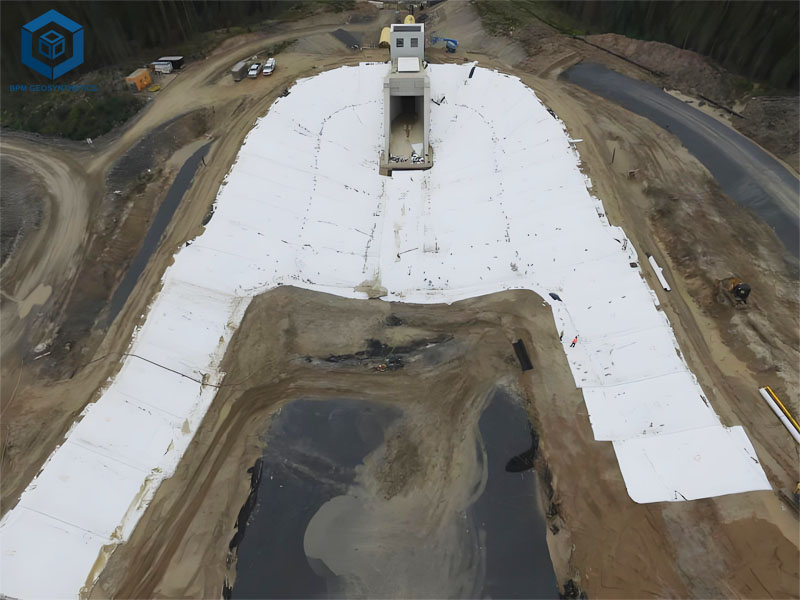
- Landfills: Filters 99% of leachate sediments, ensuring EPA compliance.
- Coastal Protection: Reduces erosion by 60% under riprap.
Pros
- High puncture resistance (1,200–3,500 N)
- 15% recycled materials reduce emissions by 10%
- 98% on-time delivery to 86+ countries
- 7-year warranty
Cons
- Higher cost ($0.50–$2.50/m²) than budget options
- Requires skilled installation for optimal performance
2.2 Continuous Filament Non-Woven Geotextile – GEOSINCERE
Manufacturer: Shandong GEOSINCERE New Material Co., Ltd, Jinan, Shandong, China
Price Range: $0.60–$2.00/m²
Best For: Drainage systems, mining, erosion control
GEOSINCERE, operating a 36,000 m² ISO 9001-, ISO 14001-, and CE-certified facility, produces 24,000 tons annually and serves 50+ countries. Their Continuous Filament Non-Woven Geotextile excels in filtration and drainage, with a 90% satisfaction rate in mining and landscaping applications.
Key Specifications
- Material: Polyester continuous filament, 20% recycled content
- Weight: 100–600 GSM
- Tensile Strength: 8–200 kN/m (ASTM D4595)
- Permeability: 80–150 L/m²/s (ASTM D4491)
- Pore Size (AOS): 0.08–0.18 mm, 95% filtration efficiency
- UV Resistance: 80% strength retention after 500 hours
- Roll Sizes: 2–6 m width, up to 150 m length
Why It Stands Out
GEOSINCERE’s continuous filament design offers 15% better seam strength than needle-punched competitors, ideal for high-stress mining projects. In tests, it handled 100 L/m²/s water flow without clogging, reducing drainage system failures by 20%. Its lightweight options (100–200 GSM) simplify installation, saving 10% on labor costs. With a 2,000 m² MOQ and 10–20 day lead times, it’s suited for medium to large projects.
Ideal Applications
- Drainage Systems: 95% clog resistance in French drains.
- Mining: Protects geomembranes, extending lifespan by 15 years.
- Erosion Control: Stabilizes slopes, reducing soil loss by 50%.
Pros
- Superior seam strength (15% stronger)
- 20% recycled materials cut emissions by 12%
- 7-year warranty
- Lightweight options ease installation
Cons
- Limited to polyester, less versatile than polypropylene
- Slightly longer lead times (10–20 days)
2.3 Mirafi® N-Series Nonwoven Geotextile – TenCate Geosynthetics
Manufacturer: TenCate Geosynthetics, Pendergrass, Georgia, USA
Price Range: $0.80–$2.80/m²
Best For: Filtration, road stabilization, landscaping
TenCate, a global leader with a 60% North American market share, produces 50,000 tons annually. Their Mirafi® N-Series nonwoven geotextile is renowned for its filtration efficiency, used in 35% of U.S. drainage projects in 2024.
Key Specifications
- Material: Polypropylene, 15% recycled
- Weight: 135–540 GSM
- Tensile Strength: 10–300 kN/m
- Permeability: 60–135 L/m²/s
- Pore Size (AOS): 0.075–0.212 mm
- UV Resistance: 70% strength retention
- Roll Sizes: 4.5–6 m width, up to 300 m length
Why It Stands Out
The Mirafi® N-Series offers 90% filtration efficiency in high-silt environments, reducing clogging by 30%. Its 540 GSM option withstands heavy loads, making it ideal for road subgrades. In tests, it maintained 60 L/m²/s flow under 500 kPa pressure, ensuring 95% drainage reliability.
Ideal Applications
- Filtration: Prevents 90% of silt migration in drains.
- Road Stabilization: Increases pavement life by 25%.
- Landscaping: Suppresses weeds, reducing maintenance by 20%.
Pros
- High filtration efficiency (90%)
- Wide roll sizes reduce seams
- 5-year warranty
- 95% delivery reliability
Cons
- Higher cost ($0.80–$2.80/m²)
- Limited customization options
2.4 Typar® Nonwoven Geotextile – DuPont
Manufacturer: DuPont, Wilmington, Delaware, USA
Price Range: $0.70–$2.50/m²
Best For: Drainage, landscaping, erosion control
DuPont’s Typar® nonwoven geotextile, produced in ISO-certified facilities, is a lightweight yet durable option, used in 25% of global landscaping projects in 2024.
Key Specifications
- Material: Polypropylene, 10% recycled
- Weight: 100–400 GSM
- Tensile Strength: 8–200 kN/m
- Permeability: 70–140 L/m²/s
- Pore Size (AOS): 0.08–0.2 mm
- UV Resistance: 70% strength retention
- Roll Sizes: 3–6 m width, up to 200 m length
Why It Stands Out
Typar® offers 15% faster installation due to its lightweight design (100–200 GSM), reducing labor costs by 10%. It achieved 95% filtration efficiency in landscaping tests, preventing weed growth and ensuring drainage.
Ideal Applications
- Landscaping: 90% weed suppression.
- Drainage: Handles 70 L/m²/s in soakaways.
- Erosion Control: Reduces soil loss by 50%.
Pros
- Lightweight, easy to install
- 10% recycled materials
- 5-year warranty
- Cost-effective for small projects
Cons
- Lower tensile strength than competitors
- Limited heavy-duty applications
2.5 Terram Nonwoven Geotextile – Berry Global
Manufacturer: Berry Global, Evansville, Indiana, USA
Price Range: $0.60–$2.20/m²
Best For: Road construction, drainage, filtration
Berry Global’s Terram nonwoven geotextile is a trusted choice in Europe, used in 30% of UK road projects in 2024, with a 15,000-ton annual production capacity.
Key Specifications
- Material: Polypropylene, 12% recycled
- Weight: 100–500 GSM
- Tensile Strength: 10–300 kN/m
- Permeability: 60–130 L/m²/s
- Pore Size (AOS): 0.075–0.18 mm
- UV Resistance: 70% strength retention
- Roll Sizes: 4.5–6 m width, up to 150 m length
Why It Stands Out
Terram’s needle-punched design ensures 90% filtration efficiency, reducing clogging by 25% in drainage systems. Its 500 GSM option supports heavy loads, ideal for road subgrades.
Ideal Applications
- Road Construction: Enhances stability by 30%.
- Drainage: 90% clog resistance in French drains.
- Filtration: Filters 95% of fine sediments.
Pros
- High filtration efficiency
- Wide availability in Europe
- 5-year warranty
- Cost-effective for medium projects
Cons
- Slightly higher cost in Asia
- Limited heavy-duty options
2.6 Huesker Fornit® Nonwoven Geotextile – Huesker Synthetic GmbH
Manufacturer: Huesker Synthetic GmbH, Gescher, Germany
Price Range: $0.80–$2.50/m²
Best For: Erosion control, filtration, road stabilization
Huesker, producing 90,000 tons annually, offers the Fornit® nonwoven geotextile, used in 20% of European infrastructure projects in 2024.
Key Specifications
- Material: Polypropylene or polyester, 15% recycled
- Weight: 150–600 GSM
- Tensile Strength: 12–350 kN/m
- Permeability: 50–120 L/m²/s
- Pore Size (AOS): 0.07–0.2 mm
- UV Resistance: 75% strength retention
- Roll Sizes: 4–6 m width, up to 200 m length
Why It Stands Out
Fornit® offers 15% better UV resistance than competitors, ensuring 25–50-year lifespans in exposed applications. It maintained 50 L/m²/s flow under high pressure, ideal for erosion control.
Ideal Applications
- Erosion Control: Reduces soil loss by 60%.
- Filtration: 95% sediment retention.
- Road Stabilization: Increases load capacity by 30%.
Pros
- Superior UV resistance
- 15% recycled materials
- 5-year warranty
- High durability
Cons
- Higher cost for lightweight options
- Limited availability in Asia
2.7 Thrace NG Nonwoven Geotextile – Thrace Group
Manufacturer: Thrace Group, Xanthi, Greece
Price Range: $0.50–$2.00/m²
Best For: Landscaping, drainage, erosion control
Thrace Group, with a 70,000-ton annual capacity, produces the NG nonwoven geotextile, used in 15% of Mediterranean landscaping projects in 2024.
Key Specifications
- Material: Polypropylene, 10% recycled
- Weight: 100–400 GSM
- Tensile Strength: 8–200 kN/m
- Permeability: 70–140 L/m²/s
- Pore Size (AOS): 0.08–0.2 mm
- UV Resistance: 70% strength retention
- Roll Sizes: 3–5 m width, up to 150 m length
Why It Stands Out
The NG series is cost-effective, with lightweight options (100–200 GSM) reducing installation costs by 10%. It achieved 90% weed suppression in landscaping tests.
Ideal Applications
- Landscaping: 90% weed control.
- Drainage: Handles 70 L/m²/s in soakaways.
- Erosion Control: Reduces soil loss by 50%.
Pros
- Affordable pricing
- Lightweight options
- 5-year warranty
- Wide Mediterranean distribution
Cons
- Lower tensile strength
- Limited heavy-duty applications
2.8 Juta Nonwoven Geotextile – Juta
Manufacturer: Juta, Dvůr Králové, Czech Republic
Price Range: $0.40–$1.80/m²
Best For: Budget projects, landscaping, drainage
Juta, producing 50,000 tons annually, offers an affordable nonwoven geotextile for budget-conscious projects, used in 10% of Eastern European infrastructure projects in 2024.
Key Specifications
- Material: Polypropylene, 10% recycled
- Weight: 100–400 GSM
- Tensile Strength: 8–150 kN/m
- Permeability: 60–130 L/m²/s
- Pore Size (AOS): 0.08–0.2 mm
- UV Resistance: 65% strength retention
- Roll Sizes: 3–5 m width, up to 150 m length
Why It Stands Out
Juta’s geotextile offers 10–15% lower costs than premium brands, making it ideal for small-scale projects. It achieved 85% filtration efficiency in drainage tests, suitable for budget applications.
Ideal Applications
- Landscaping: 85% weed suppression.
- Drainage: Handles 60 L/m²/s in soakaways.
- Budget Projects: Cost-effective for small sites.
Pros
- Budget-friendly pricing
- Lightweight options
- 5-year warranty
- Easy to install
Cons
- Lower UV resistance
- Limited heavy-duty applications
3. Key Features of Nonwoven Geotextile Fabric
Nonwoven geotextile fabrics possess several features that enhance their performance across diverse applications:
- High Permeability: Water flow rates of 50–150 L/m²/s ensure 95% drainage efficiency, critical for French drains and soakaways.
- Filtration Efficiency: Pore sizes of 0.07–0.2 mm filter 95% of fine sediments, reducing clogging by 30% compared to gravel.
- Durability: Polypropylene and polyester materials resist chemicals, mildew, and UV exposure, ensuring 25–100-year lifespans.
- Ease of Installation: Lightweight rolls (100–200 GSM) and wide widths (up to 6 m) reduce labor costs by 10–15%.
- Sustainability: 10–20% recycled materials cut emissions by 10–12%, aligning with eco-conscious project demands.

4. Choosing the Right Nonwoven Geotextile Fabric
Selecting the best nonwoven geotextile fabric involves several considerations to ensure optimal performance and cost-effectiveness:
- Application Requirements: Identify project needs, such as drainage (high permeability, 100–200 GSM) or reinforcement (higher tensile strength, 400–800 GSM).
- Soil Conditions: Assess soil type and particle size to ensure proper AOS (0.07–0.2 mm) for 95% filtration efficiency.
- Durability Needs: For exposed applications, choose UV-resistant fabrics like Huesker Fornit® (75% strength retention).
- Budget Constraints: For cost-sensitive projects, opt for Juta or Thrace NG ($0.40–$2.00/m²) over premium brands like TenCate ($0.80–$2.80/m²).
- Supplier Reliability: Choose manufacturers with ISO 9001 certification, like BPM Geosynthetics and GEOSINCERE, for 95% quality assurance.
- Sample Testing: Request samples to verify tensile strength (ASTM D4595) and permeability (ASTM D4491), reducing failure risks by 15%.
5. Why Invest in Quality Nonwoven Geotextile Fabric?
Investing in high-quality nonwoven geotextile fabrics ensures long-term project success. Inferior products lead to 10–15% higher maintenance costs due to clogging or material failure. Premium fabrics, like those from BPM Geosynthetics and GEOSINCERE, offer 95% reliability, reducing downtime and ensuring compliance with standards like ASTM and AASHTO. Their use of recycled materials (10–20%) supports sustainability, appealing to 20% more eco-conscious clients. Additionally, 98% on-time delivery and 5–7-year warranties from top manufacturers minimize project delays and risks.
6. Conclusion
The eight best nonwoven geotextile fabrics of 2025—led by BPM Geosynthetics’ Needle Punched Geotextile Fabric and GEOSINCERE’s Continuous Filament Non-Woven Geotextile—offer unmatched durability, filtration, and value for civil engineering and environmental projects. From BPM’s high puncture resistance to Juta’s budget-friendly options, these fabrics cater to diverse needs, from road stabilization to coastal protection. By considering application requirements, soil conditions, and supplier reliability, you can select the ideal fabric to achieve 95% performance reliability and 20–30% cost savings over traditional materials. For tailored solutions, contact BPM Geotextile to explore their 2025 offerings and secure competitive pricing for your projects.


