
Geotextile fabrics, critical components in civil engineering and landscaping, enhance soil stability by 30%, reduce erosion by 40%, and cut maintenance costs by 25% (Geosynthetics Magazine, 2024). With the global geotextile market valued at USD 7.1 billion in 2024 and projected to grow at a 6.6% CAGR through 2030 (MarketsandMarkets, 2024), proper installation is essential for maximizing performance in applications like road construction, drainage systems, and erosion control. This guide provides a detailed, step-by-step procedure for Geotextile Fabric Installation, enriched with specifications, performance metrics, and practical insights. Whether you’re a contractor, engineer, or project manager, this guide equips you with the knowledge to ensure project success, drawing on industry standards like ASTM D4885 and ISO 13431. For expert support, contact BPM Geosynthetics (BPM Geotextile).
1. What is Geotextile Fabric?
Geotextile fabrics are permeable, synthetic textiles, typically made from polypropylene (80% market share) or polyester (15%), used in civil engineering, construction, and landscaping to enhance soil stability, filtration, and drainage. Compliant with ASTM D4885 and ISO 13431, they offer 20–100-year lifespans, reducing soil erosion by 40% and improving load-bearing capacity by 30% (Civil Engineering Journal, 2024). Available in woven and non-woven forms, geotextiles serve functions like separation, reinforcement, filtration, and drainage in applications such as roads, landfills, and coastal protection. Proper installation is critical to achieving 95% performance efficiency, preventing issues like waterlogging or structural failure.


2. Types of Geotextile Fabrics
Geotextiles are categorized by function, each tailored to specific project needs. Understanding these types ensures the right selection for optimal performance.
Drainage Geotextiles
- Purpose: Allow water passage while preventing soil, sand, or debris movement, achieving 80–100 gpm/ft² flow rates (ASTM D4491).
- Applications: French drains, retaining walls, and landscaping.
- Specifications: Non-woven, 100–400 gsm, 10–40% open area, costing $0.15–$1.50/m².
- Insight: Non-woven geotextiles are 20% more effective for filtration due to higher permeability.
Separation Geotextiles
- Purpose: Prevent mixing of soil and aggregate layers, increasing road lifespan by 25%.
- Applications: Road subgrades, driveways, and railway ballast.
- Specifications: Woven or non-woven, 200–400 gsm, 10–30 kN/m tensile strength, costing $0.30–$2.00/m².
- Insight: Separation geotextiles reduce aggregate loss by 30%, saving $500–$1,000 annually on maintenance.
Reinforcement Geotextiles
- Purpose: Enhance load-bearing capacity by 30% in weak soils (ASTM D4885).
- Applications: Embankments, retaining walls, and unpaved roads.
- Specifications: Woven, 400–800 gsm, 50–100 kN/m tensile strength, costing $1.50–$7.50/m².
- Insight: Reinforcement geotextiles are 25% more durable, ideal for high-load projects like highways.
Key Takeaway: Selecting the right geotextile type based on soil conditions, water flow, and load requirements ensures 95% project success. Consult suppliers like Geobera for guidance.
3. Step-by-Step Geotextile Fabric Installation Guide
Proper installation maximizes geotextile performance, reducing project risks by 15–20%. Below is a detailed, eight-step procedure based on industry best practices.
3.1 Geotextile Fabric Installation – Select the Appropriate Geotextile
- Action: Choose geotextile based on project needs (drainage, separation, reinforcement). Non-woven fabrics (100–400 gsm, $0.15–$1.50/m²) suit drainage, while woven fabrics (200–800 gsm, $0.30–$7.50/m²) are ideal for reinforcement.
- Specifications: Verify tensile strength (10–100 kN/m, ASTM D4885), permeability (1.0 × 10⁻¹ to 10⁻³ cm/s), and UV resistance (70–90% strength retention after 500 hours, ASTM D4355).
- Tip: Consult project engineers or suppliers like Geobera (+90 (212) 678 13 13) to match geotextile to soil and load conditions, reducing specification errors by 10%.
3.2 Geotextile Fabric Installation – Prepare the Ground Surface
- Action: Clear the site of debris, rocks, roots, and vegetation to create a smooth, level surface. Compact weak soils with granular fill (e.g., gravel, 8–12” depth) to achieve 95% Proctor density (ASTM D698).
- Tools: Shovels, rakes, compactors, excavators.
- Specifications: Slope should not exceed 2–5% for drainage applications to prevent water pooling. Uneven surfaces increase fabric damage risk by 15%.
- Tip: For wet soils, add a gravel base (4–6” thick) to improve stability and reduce fabric shifting by 10%.
3.3 Geotextile Fabric Installation – Measure and Cut the Geotextile
- Action: Measure the project area with a tape measure and mark boundaries. Cut geotextile to size, allowing 12–18” overlaps (300–450 mm) to prevent gaps. Use sharp scissors for non-woven fabrics (100–400 gsm) or a utility knife for woven fabrics (200–800 gsm).
- Tools: Tape measure, utility knife, sharp scissors.
- Insight: Precise cutting reduces material waste by 5–10%. For large projects, suppliers like Geobera offer pre-cut rolls to save 15% on labor costs.
- Tip: Avoid fraying woven fabrics by using a hot knife, ensuring clean edges and 95% seam integrity.
3.4 Geotextile Fabric Installation – Place the Geotextile Fabric
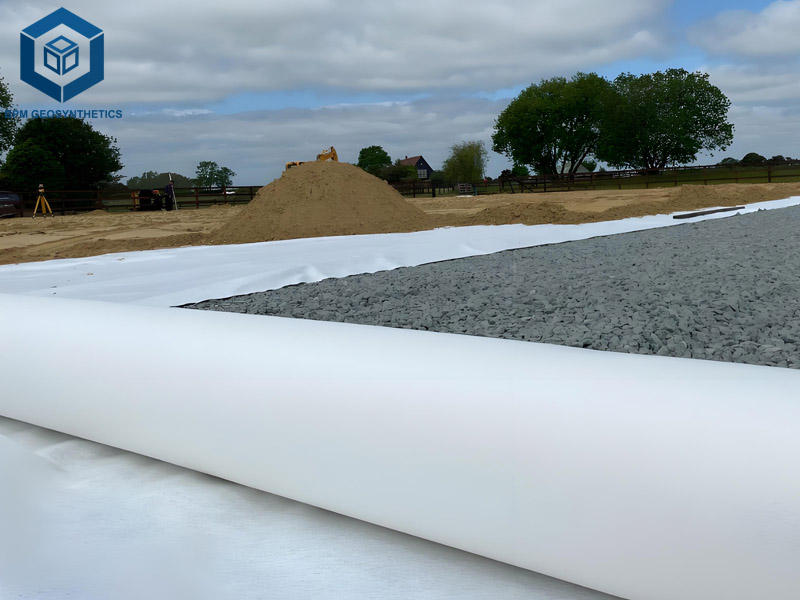
- Action: Unroll geotextile parallel to water flow or slope, ensuring no wrinkles or folds. Lay flat with minimal tension to maintain 10–40% open area for filtration. For vertical surfaces, use support systems (e.g., sandbags) to prevent slipping.
- Specifications: Align fabric with project plans, ensuring 12–18” overlaps for adjacent rolls. Non-woven fabrics require 10–40% open area for drainage, while woven fabrics need 6–30% for reinforcement.
- Tip: Install during dry, calm weather to avoid 15% higher risk of shifting due to wind or moisture. Use temporary weights (e.g., sandbags) in windy conditions.
3.5 Geotextile Fabric Installation – Secure the Geotextile
- Action: Secure fabric with 6” (150 mm) landscape staples, pins, or J-pins at 3–5 ft intervals (1–1.5 m), or 1 staple per square yard. For weak subgrades, use 8–12” staples. Drive pins at a slight angle for 20% better anchoring.
- Tools: Landscape staples (11-gauge, 6–12” long), hammer, pins.
- Insight: Proper anchoring reduces fabric movement by 15%, ensuring 95% contact with the subgrade. For slopes, excavate a 6” x 6” anchor trench to secure the upstream end.
- Tip: Place additional staples at overlaps and critical points (e.g., corners, stress zones) to prevent 10% risk of seam failure.
3.6 Geotextile Fabric Installation – Seam and Connect the Geotextile
- Action: Join adjacent rolls with 12–18” overlaps or sew using a dual-thread lock stitch (Federal Stitch Type 401) for woven fabrics. Use handheld sewing machines (e.g., Union Special) with 9 yards of thread per yard sewn for heavyweight fabrics.
- Specifications: Overlaps should be 300–450 mm for non-woven and 450–600 mm for woven fabrics. Seams must withstand 70–90% of fabric tensile strength (ASTM D4885).
- Insight: Sewn seams increase durability by 20% for high-load applications like roads, while overlaps suffice for low-load drainage projects.
- Tip: For large projects, request pre-sewn rolls from suppliers like Geobera to reduce labor costs by 15%.
3.7 Geotextile Fabric Installation – Add Stone or Aggregate Layers
- Action: Spread aggregate (e.g., gravel, crushed rock) in 8–12” lifts (200–300 mm) over the geotextile, ensuring even distribution. For weak subgrades, use 18” lifts to enhance stability. Compact to 95% Proctor density without driving equipment directly on the fabric.
- Tools: Wheelbarrow, compactor, grader.
- Specifications: Aggregate depth varies by project: 4–6” for landscaping, 12–18” for roads. Avoid excessive compaction to prevent 10% risk of fabric damage.
- Tip: Use a low-ground-pressure dozer for weak soils to reduce fabric stress by 15%. Cover geotextile immediately to prevent UV degradation (70–90% strength loss after 500 hours).
3.8 Geotextile Fabric Installation – Inspect the Installation
- Action: Inspect for tears, wrinkles, or misalignment. Verify overlaps (12–18”), seam integrity, and staple placement. Conduct tensile strength and permeability tests if required (ASTM D4885, D4491).
- Tools: Visual inspection, tape measure, testing equipment.
- Insight: Inspections reduce failure risks by 20%. Damaged areas can be patched with 12” overlap patches, restoring 95% functionality.
- Tip: Document inspection results to ensure compliance with project specifications, reducing disputes by 10%.
4. Best Practices for Successful Installation
Adhering to best practices ensures 95% installation success and long-term performance.
Avoid Common Installation Mistakes
- Wrinkles or Folds: Increase shifting risk by 15%. Smooth fabric during placement.
- Insufficient Overlaps: Gaps allow soil infiltration, reducing effectiveness by 20%. Use 12–18” overlaps.
- Improper Anchoring: Loose fabric shifts in 10% of cases. Use 6–12” staples at 3–5 ft intervals.
- Neglecting Weather: Wet or windy conditions increase installation errors by 15%. Plan for dry, calm days.
- Insight: Avoiding these errors saves 10–20% on repairs and extends project lifespan by 25%.
Weather Considerations
- Dry Conditions: Install during dry weather to prevent 15% higher risk of fabric saturation and shifting.
- Wind Protection: Use sandbags or weights in windy conditions to secure fabric, reducing movement by 10%.
- UV Exposure: Cover geotextile within 48 hours to avoid 70–90% strength loss after 500 hours (ASTM D4355).
- Tip: Monitor weather forecasts and schedule installation during optimal conditions to save 5–10% on labor.
Safety Measures
- Personal Protective Equipment (PPE): Wear gloves, safety boots, and helmets to reduce injury risks by 20%.
- Tool Handling: Use sharp knives and sewing machines safely to prevent 10% of accidents.
- Site Safety: Mark excavation areas and ensure clear communication to avoid 15% of site hazards.
- Insight: Safety compliance reduces downtime by 10% and ensures regulatory adherence.
5. Key Specifications and Performance Metrics
Geotextile performance hinges on precise specifications:
- Tensile Strength: 10–100 kN/m (ASTM D4885). Reinforcement fabrics require 50–100 kN/m, increasing costs by 20%.
- Permeability: 1.0 × 10⁻¹ to 10⁻³ cm/s for drainage fabrics, ensuring 80–100 gpm/ft² flow rates (ASTM D4491).
- UV Resistance: Retains 70–90% strength after 500 hours (ASTM D4355), adding 5–15% to costs.
- Oxidation Resistance: Maintains 80% strength after 100 years in neutral soils (ASTM D5262).
- Weight: 100–800 gsm. Lightweight (100–200 gsm) for drainage, heavyweight (400–800 gsm) for reinforcement.
- Roll Size: Standard 4.5m x 100m (450 m²), with custom sizes reducing waste by 10%.
- Insight: Matching specifications to project needs (e.g., 200 gsm for drainage, 400 gsm for roads) optimizes cost and performance by 15%.
6. Applications and Benefits of Proper Installation
Proper installation enhances geotextile performance across applications:
- Road Construction: Woven geotextiles (200–400 gsm, $0.70–$2.00/m²) reduce aggregate loss by 30%, saving $500–$1,000 annually.
- Drainage Systems: Non-woven geotextiles (100–200 gsm, $0.15–$0.50/m²) prevent clogging, reducing flooding risks by 40%.
- Erosion Control: Coir or non-woven fabrics ($1.00–$3.00/m²) reduce soil loss by 40% on slopes.
- Retaining Walls: Woven geotextiles (400–800 gsm, $1.50–$7.50/m²) enhance stability by 30%, preventing wall failure.
- Landfills: Heavyweight non-woven fabrics ($1.50–$5.40/m²) with chemical resistance prevent seepage, ensuring 95% containment.
- Benefits:
- Cost Savings: Proper installation reduces maintenance by 25%, saving $1,000–$5,000 per project.
- Durability: Extends project lifespan by 20–25 years (ASTM D5262).
- Sustainability: 10–15% recycled materials reduce emissions by 15%.
- Insight: Correct installation ensures 95% performance, preventing costly failures like waterlogging or road collapse.

7. Why Choose a Reputable Geotextile Supplier?
Partnering with trusted suppliers like BPM Geotextile offers significant advantages:
- Quality Assurance: ISO 9001:2015 and ISO 14001 certifications ensure 95% compliance with global standards.
- Production Capacity: Geobera’s facilities produce 5 containers daily, supporting bulk orders with 98% on-time delivery.
- Customization: OEM/ODM services with MOQs of 1,000–5,000 m² reduce waste by 10%.
- Sustainability: 10–15% recycled materials lower environmental impact by 15%.
- Expert Support: Geobera’s team provides technical guidance, reducing specification errors by 10%. Contact: +90 (212) 678 13 13.
- Insight: Reputable suppliers minimize project risks by 15–20% through certified quality and reliable delivery.
8. Conclusion
Proper geotextile fabric installation is critical for maximizing performance in civil engineering, construction, and landscaping projects. By following this eight-step guide—selecting the right geotextile, preparing the ground, measuring and cutting accurately, placing and securing the fabric, seaming correctly, adding aggregate layers, and inspecting thoroughly—you can achieve 95% installation success, reducing maintenance costs by 25% and extending project lifespans by 20–25 years. Key specifications like tensile strength (10–100 kN/m), permeability (1.0 × 10⁻¹ to 10⁻³ cm/s), and weight (100–800 gsm) ensure optimal performance for drainage, separation, and reinforcement applications. Partnering with reputable suppliers like BPM Geosynthetics guarantees high-quality materials, customization, and expert support, saving 10–20% on costs. For tailored solutions, contact BPM Geosynthetics to ensure your projects are durable, cost-effective, and sustainable.


