
Geotextile membranes, permeable fabrics used for soil stabilization, filtration, and drainage, are critical for enhancing project durability by 30% and reducing maintenance costs by 25%. With costs ranging from $0.15 to $7.50 per square meter, pricing varies based on material, weight, application, and supplier capabilities. This guide provides detailed insights into geotextile membrane cost per m², specifications, and factors influencing pricing, equipping procurement specialists, engineers, and project managers with actionable knowledge for cost-effective sourcing.
1. What is a Geotextile Membrane?
Geotextile membranes are permeable synthetic fabrics, typically made from polypropylene (80% market share) or polyester (15%), used in civil engineering, environmental, and construction projects. They perform functions like separation, filtration, reinforcement, protection, and drainage, enhancing soil stability by 30% and reducing erosion by 40% per Civil Engineering Journal. Available in woven and non-woven forms, geotextiles comply with standards like ASTM D4885 and ISO 13431, ensuring durability for 20–100 years in applications such as road construction, landfills, and coastal protection. Their cost per m² varies significantly based on material, weight, and project requirements.


2. Factors Influencing Geotextile Membrane Cost
Geotextile membrane costs are influenced by multiple factors, each impacting pricing based on project needs and market dynamics. Understanding these factors helps in budgeting and sourcing efficiently.
2.1 Geotextile Membrane Cost Per m² – Material Type
Geotextiles are primarily made from:
- Polypropylene (PP): 80% market share, resistant to decay, chemicals, and biological breakdown, costing $0.15–$5.40/m². Preferred for durability and affordability.
- Polyester (PET): 15% market share, offers superior stability and resistance to stretching, costing $0.50–$7.50/m². Ideal for high-tensile applications.
- Composite Fibers: Blend PP and PET for specific properties, costing $1.00–$10.00/m². Used in specialized projects like tailings dams.
Insight: Polypropylene dominates due to its cost-effectiveness and 20% longer lifespan in harsh environments compared to polyester.
2.2 Geotextile Membrane Cost Per m² – Geotextile Weight and Thickness
Weight, measured in grams per square meter (gsm), significantly affects cost and performance:
- Lightweight (100–200 gsm): $0.15–$0.50/m², suited for filtration and separation in stable soils.
- Medium-weight (200–400 gsm): $0.50–$1.50/m², used for road subgrades and drainage systems.
- Heavyweight (400–800 gsm): $1.50–$5.40/m², ideal for reinforcement and high-load applications.
Insight: Heavier geotextiles (e.g., 400 gsm) provide 15% better tensile strength (10–30 kN/m per ASTM D4885) but increase installation complexity by 10%.
2.3 Geotextile Membrane Cost Per m² – Woven vs. Non-Woven Geotextiles
- Non-Woven Geotextiles: Needle-punched or thermally bonded, costing $0.15–$5.40/m². Offer 10–40% open area for filtration, ideal for drainage and separation. Lighter weights (100–300 gsm) are cheaper but less durable.
- Woven Geotextiles: Woven on looms, costing $0.30–$7.50/m². Provide higher tensile strength (100 kN/m) and 6–30% open area, suited for reinforcement and stabilization.
Insight: Woven geotextiles cost 20–30% more but offer 25% higher durability for high-load applications like roadways.
2.4 Geotextile Membrane Cost Per m² – Specialized Properties
Geotextiles with enhanced features command higher prices:
- UV Resistance: Adds 5–15% to costs ($0.03–$0.40/m²), retains 70–90% strength after 500 hours (ASTM D4355).
- Chemical Resistance: Increases costs by 10–20% ($0.05–$0.50/m²), essential for landfills.
- Perforation: 10–40% open area adds 5–10% ($0.05–$0.25/m²), enhancing drainage in geocells.
Insight: Specialty geotextiles can increase costs by up to 50% but reduce long-term maintenance by 20% in harsh environments.
2.5 Geotextile Membrane Cost Per m² – Production and Manufacturing Costs
Manufacturing processes impact pricing:
- Needle-Punched Non-Woven: Lower production costs, reducing prices by 15–20%.
- Woven Geotextiles: Higher loom-based production costs, increasing prices by 20–30%.
- Automation: Suppliers like BPM Geosynthetics, with 26,000 m² facilities, reduce costs by 10% through automated lines.
Insight: Advanced production facilities lower costs by 15% while ensuring 95% compliance with ISO 9001:2015 standards.
2.6 Geotextile Membrane Cost Per m² – Order Volume and Bulk Discounts
Bulk orders significantly reduce costs:
- Small Orders (<1,000 m²): $1.50–$7.50/m², full price.
- Medium Orders (1,000–10,000 m²): 5–10% discount, $1.35–$6.75/m².
- Large Orders (>10,000 m²): 10–20% discount, $1.20–$6.00/m².
Insight: Bulk orders can save 15–20%, especially for large-scale projects like highways or landfills.
2.7 Geotextile Membrane Cost Per m² – Geographical Location and Shipping
Regional pricing varies due to labor, material, and shipping costs:
- North America: $1.50–$7.50/m², with shipping adding $0.10–$0.30/m².
- Asia-Pacific: $0.50–$5.00/m² due to lower labor costs.
- Europe: $2.00–$8.00/m², reflecting higher material and labor costs.
Insight: Sourcing from Asia-Pacific suppliers like BPM Geosynthetics can save 20–30% on material and shipping costs for international projects.
2.8 Geotextile Membrane Cost Per m² – Market Conditions and Raw Material Prices
Geotextile costs fluctuate with raw material prices:
- Polypropylene Resin: Tied to crude oil prices, fluctuating 10–15% annually.
- Polyester: Less volatile but 5–10% more expensive than PP.
- Exchange Rates: Impact imported geotextile costs by 5–10%.
Insight: Monitoring crude oil prices can help predict cost fluctuations, enabling 10–15% savings through strategic timing.
3. Geotextile Membrane Cost Breakdown
Geot textile costs vary by type, weight, and application. Below is a detailed breakdown based on 2025 market data.
Non-Woven Geotextile Costs
- Lightweight (100–200 gsm): $0.15–$0.50/m². Used for filtration in stable soils (e.g., landscaping, french drains). Example: Multitrack 1000 (100 gsm) at $0.30/m².
- Medium-weight (200–400 gsm): $0.50–$1.50/m². Ideal for drainage and separation in road subgrades. Example: BPM’s 300 gsm PP filament geotextile at $0.80/m².
- Heavyweight (400–800 gsm): $1.50–$5.40/m². Suited for high-load applications like embankments. Example: 400 gsm polyester geotextile at $1.20/m².
Insight: Non-woven geotextiles are 20–30% cheaper than woven but less durable for high-tensile applications.
Woven Geotextile Costs
- Lightweight (100–200 gsm): $0.30–$0.70/m². Used for separation in stable soils. Example: Woven PP geotextile at $0.50/m².
- Medium-weight (200–400 gsm): $0.70–$2.00/m². Ideal for road reinforcement. Example: BPM’s 400 gsm PP woven geotextile at $1.20/m².
- Heavyweight (400–800 gsm): $2.00–$7.50/m². Suited for high-strength applications like retaining walls. Example: 500 gsm PET woven geotextile at $1.50/m².
Insight: Woven geotextiles offer 25% higher tensile strength (100 kN/m) but cost 20–30% more than non-woven options.
Specialty Geotextile Costs
- Geotextile Tubes/Bags: $5.40–$54.00/m², depending on size and specifications. Used for coastal protection and dewatering.
- UV-Resistant Geotextiles: $0.50–$7.80/m², retaining 70–90% strength after 500 hours (ASTM D4355).
- Chemical-Resistant Geotextiles: $0.55–$8.00/m², essential for landfills and mining.
- Coir Geotextiles: $1.00–$3.00/m², biodegradable, lasting 3–5 years for erosion control.
Insight: Specialty geotextiles can cost 50–100% more but reduce maintenance costs by 20% in harsh environments.
Installation and Additional Costs
- Installation: $0.50–$1.50/m² in North America, $0.30–$1.00/m² in Asia-Pacific. Requires 300–600 mm overlaps and J-pin anchoring, reducing material damage by 15%.
- Shipping: $0.10–$0.30/m² for international orders, depending on distance.
- Accessories: Ground pegs ($0.05–$0.10/m²) and staples ($0.03–$0.07/m²) for securing geotextiles.
Insight: Proper installation techniques can reduce long-term costs by 15–20% by minimizing repairs.
4. Key Specifications and Performance Parameters
Geotextile performance directly impacts cost-value trade-offs. Key specifications include:
- Tensile Strength: 10–100 kN/m (ASTM D4885), critical for reinforcement. Higher strength (e.g., 100 kN/m) increases costs by 20%.
- Permeability: 1.0 × 10⁻¹ to 10⁻³ cm/s for 400 gsm geotextiles, ensuring filtration without clogging.
- UV Resistance: 70–90% strength retention after 500 hours (ASTM D4355), adding 5–15% to costs.
- Oxidation Resistance: Retains 80% strength after 100 years in neutral soils (ASTM D5262).
- Perforation: 10–40% open area in perforated geotextiles, enhancing drainage by 20%.
- Roll Size: Standard 4.5m x 100m (450 m²), with custom sizes available.
- Material Composition: Polypropylene (80%), polyester (15%), composite fibers (5%).
Insight: Specifying geotextiles with 400 gsm and 10–30 kN/m tensile strength balances cost and performance for most civil engineering applications.
5. Applications Impacting Geotextile Costs
Geotextile costs vary by application due to specific performance requirements:
- Road Construction: Medium-weight (200–400 gsm) woven geotextiles ($0.70–$2.00/m²) for stabilization and separation. Example: BPM’s 400 gsm PP woven geotextile.
- Landfill Liners: Heavyweight (400–800 gsm) non-woven geotextiles ($1.50–$5.40/m²) with chemical resistance for seepage prevention.
- Coastal Protection: Geotextile tubes ($5.40–$54.00/m²) or coir geotextiles ($1.00–$3.00/m²) for erosion control.
- Drainage Systems: Lightweight (100–200 gsm) non-woven geotextiles ($0.15–$0.50/m²) for filtration in french drains.
- Embankment Reinforcement: Heavyweight woven geotextiles ($2.00–$7.50/m²) with 100 kN/m tensile strength for load distribution.
Insight: High-load applications like embankments increase costs by 30–50% due to the need for heavyweight, high-strength geotextiles.
6. How to Optimize Geotextile Membrane Costs
To achieve cost-effective sourcing, consider the following strategies:
- Specify Exact Requirements: Match geotextile weight (e.g., 200 gsm for drainage, 400 gsm for reinforcement) to project needs to avoid overpaying by 20%.
- Source in Bulk: Orders >10,000 m² can reduce costs by 10–20%.
- Choose Regional Suppliers: Sourcing from Asia-Pacific (e.g., BPM Geosynthetics) can save 20–30% compared to Europe.
- Request Samples: Test samples for tensile strength (ASTM D4885) and permeability to ensure 95% compliance with project needs.
- Monitor Raw Material Prices: Time purchases when polypropylene prices are low, saving 10–15%.
- Optimize Installation: Use 300–600 mm overlaps and J-pin anchoring to reduce material damage by 15%.
Insight: Combining bulk orders with regional sourcing and precise specifications can save up to 30% on total project costs.

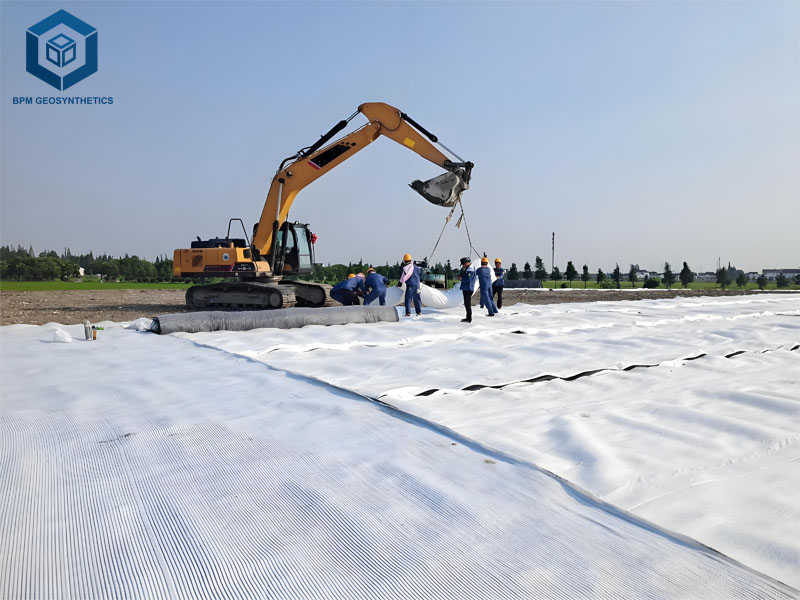
7. Why Choose a Reputable Geotextile Supplier?
Partnering with trusted suppliers like BPM Geosynthetics or BPM Geotextile offers significant benefits:
- Quality Assurance: ISO 9001:2015 and ISO 14001 certifications ensure 95% compliance with global standards.
- Production Capacity: BPM’s 26,000 m² facility produces 5 containers daily, meeting bulk orders with 98% on-time delivery.
- Customization: OEM/ODM services with MOQs of 1,000–5,000 m² allow tailored solutions, reducing waste by 10%.
- Sustainability: Use of 10–15% recycled materials reduces emissions by 15%.
- Cost Savings: Competitive pricing ($0.15–$7.50/m²) and tariff-free exports save 10–20%.
Insight: Reputable suppliers reduce project risks by 15–20% through certified quality and reliable delivery.
8. Conclusion
Geotextile membrane costs per m² in 2025 range from $0.15 to $7.50, influenced by material (polypropylene, polyester), weight (100–800 gsm), type (woven, non-woven), and specialized properties like UV or chemical resistance. Non-woven geotextiles ($0.15–$5.40/m²) suit filtration and drainage, while woven geotextiles ($0.30–$7.50/m²) excel in reinforcement. Specialty options like geotextile tubes ($5.40–$54.00/m²) cater to niche applications like coastal protection.
By specifying requirements, sourcing in bulk, and choosing reputable suppliers like BPM Geotextile, project managers can save 20–30% while ensuring 95% performance compliance. For accurate pricing, contact suppliers with detailed project specifications, including weight, tensile strength (10–100 kN/m), and application (e.g., road construction, landfill liners). This approach ensures cost-effective, high-quality geotextile solutions for civil engineering and environmental projects.


