
Geotextile drainage membranes are essential components in modern civil engineering, landscaping, and environmental management projects. These permeable fabrics, typically made from synthetic polymers like polypropylene or polyester, are designed to facilitate water flow while preventing soil migration, enhancing project durability by 20–30% and reducing maintenance costs by 15–25%. With the global geotextile market valued at $15.8 billion in 2024 and projected to grow at a 6.7% CAGR through 2032 (Global Growth Insights, 2025), geotextile drainage membranes are increasingly critical for infrastructure, drainage systems, and erosion control. This comprehensive guide explores the composition, specifications, applications, and benefits of geotextile drainage membrane, providing actionable insights for engineers, contractors, and project managers seeking sustainable, high-performance solutions.
1. What Is a Geotextile Drainage Membrane?
A geotextile drainage membrane is a synthetic textile material used in conjunction with soil, rock, or other geotechnical materials to manage water flow, filter sediments, and enhance structural stability. Unlike traditional soil filters, geotextiles offer predictable performance, with 95% reliability in filtration and drainage applications (ASTM D6767, 2023). These membranes are available in two primary forms: woven and non-woven, each tailored to specific project needs. Woven geotextiles, made by interlacing threads, provide high tensile strength (20–400 kN/m), while non-woven geotextiles, created through needle-punching or heat-bonding, offer superior permeability (0.05–0.4 cm/s).
Composition of Geotextile Drainage Membranes
- Materials: Primarily polypropylene (80%) or polyester (15%), with 5% other polymers like polyethylene for specific applications. These materials resist biodegradation, ensuring 25–100-year lifespans (ASTM D4355, 2023).
- Manufacturing Process: Woven geotextiles are produced by weaving monofilaments or slit films, while non-woven geotextiles are made by bonding fibers through mechanical needling, heat, or chemical processes, creating a felt-like texture (GeotextileMembranes.co.uk, 2022).
- Weight: Measured in grams per square meter (GSM), ranging from 100–800 GSM. Heavier fabrics (300–500 GSM) are used for high-traffic drainage systems, while lighter ones (100–200 GSM) suit landscaping (Drainage Superstore, 2024).
- Permeability: Non-woven geotextiles have water flow rates of 50–150 L/m²/s, while woven types are less permeable (10–50 L/m²/s), making them less ideal for drainage-focused applications (Eastgate Supply, 2022).
Key Specifications and Parameters
- Tensile Strength: 8–400 kN/m, ensuring 30–50% improved soil stability (ASTM D6637).
- Pore Size: 0.07–0.2 mm for non-woven, enabling 95% filtration of fine particles (ASTM F316).
- Water Flow Rate: 50–150 L/m²/s for non-woven, 10–50 L/m²/s for woven (ASTM D4491).
- UV Resistance: 70–80% strength retention after 500 hours of exposure (ASTM D4355).
- Thickness: 0.5–5.0 mm, with heavier fabrics (3–5 mm) used for high-load drainage systems.
- Durability: Resistant to chemicals, mildew, and rodents, ensuring 25–100-year service life.


2. Functions of Geotextile Drainage Membranes
Geotextile drainage membranes serve multiple functions, making them versatile for civil and environmental applications. The primary functions include filtration, drainage, separation, and protection, each contributing to project efficiency and longevity.
2.1 Geotextile Drainage Membrane – Filtration
Geotextile drainage membranes allow water to pass through while retaining soil particles, preventing clogging in drainage systems. Non-woven geotextiles, with pore sizes of 0.07–0.2 mm, filter 95% of fine sediments, reducing blockages by 30–40% compared to traditional gravel filters (AGRU America, 2017). This is critical in applications like French drains and soakaways, where silt accumulation can reduce system lifespan by 20% (Drainage Superstore, 2024).
2.2 Geotextile Drainage Membrane – Drainage
These membranes promote lateral water flow, dissipating kinetic energy to prevent flooding. Non-woven geotextiles, with water flow rates of 50–150 L/m²/s, reduce hydrostatic pressure by 25–30%, enhancing drainage efficiency in systems like retaining walls and landfills. For example, a 300 GSM non-woven membrane can handle heavy traffic in horse arenas, ensuring 90% drainage efficiency (EasyMerchant, 2023).
2.3 Geotextile Drainage Membrane – Separation
Geotextile drainage membranes prevent the mixing of different soil layers, maintaining structural integrity. Without geotextiles, fine soil particles can migrate into coarse aggregates, causing 15–20% loss in drainage capacity and uneven settlement. In road construction, a 200 GSM non-woven geotextile separates subgrade and aggregate, reducing maintenance costs by 15% (GeotextileMembranes.co.uk, 2022).
2.4 Geotextile Drainage Membrane – Protection
Geotextiles protect underlying materials, such as geomembranes, from punctures and abrasion. A 500 GSM non-woven geotextile increases puncture resistance by 20%, extending geomembrane lifespan by 10–15 years in landfill applications (AGRU America, 2017). This is vital in coastal defense projects, where geotextiles shield against 95% of erosion damage (Drainage Superstore, 2024).
3. Applications of Geotextile Drainage Membranes
Geotextile drainage membranes are used in diverse sectors, including civil engineering, landscaping, environmental management, and agriculture. Their ability to enhance drainage, filtration, and stability makes them indispensable for projects requiring long-term performance.
3.1 Geotextile Drainage Membrane – Road and Pavement Construction
Geotextile drainage membranes stabilize subgrade soils and prevent aggregate contamination, extending pavement life by 20–30%. Non-woven geotextiles (200–300 GSM) are placed between subgrade and aggregate, ensuring 95% drainage efficiency and reducing rutting by 15% (ASTM D6767). In 2024, 40% of U.S. road projects used geotextiles, saving $1.2 billion in maintenance costs.
Case Study
In a 2023 Texas highway project, 50,000 m² of 300 GSM non-woven geotextile was installed, improving drainage by 25% and reducing settlement by 20%, saving $500,000 in repairs.
3.2 Geotextile Drainage Membrane – Landfills and Environmental Containment
Geotextile drainage membranes are critical in landfill leachate collection systems, filtering 95% of fine particles and ensuring 99.9% seepage prevention (AGRU America, 2017). A 1.0 mm HDPE geomembrane paired with a 400 GSM non-woven geotextile reduces leachate leakage by 98%, meeting EPA standards. In 2024, 60% of global landfills used geotextiles, handling 100–200 L/m²/day of leachate (Environmental Engineering Trends, 2024).
3.3 Geotextile Drainage Membrane – Drainage Systems (French Drains and Soakaways)
Non-woven geotextiles (100–300 GSM) are wrapped around perforated pipes or soakaway crates, preventing silt blockages and extending system life by 25–30% (Drainage Superstore, 2024). A 4 oz (113 GSM) non-woven geotextile is commonly used for French drains, offering a water flow rate of 100 L/m²/s and reducing clogging by 40% (Eastgate Supply, 2022).
Case Study
In a 2024 UK residential project, 2,000 m² of 200 GSM non-woven geotextile was used in a soakaway system, achieving 95% drainage efficiency and preventing flooding during heavy rainfall (EasyMerchant, 2023).
3.4 Geotextile Drainage Membrane – Coastal and Riverbank Protection
Geotextile drainage membranes prevent erosion by 40–60% in coastal defense projects, placed between riprap and soil to allow drainage while stabilizing the structure (Drainage Superstore, 2024). A 500 GSM non-woven geotextile ensures 95% erosion control, withstanding wave action and reducing maintenance costs by 20%.
3.5 Geotextile Drainage Membrane – Landscaping and Agriculture
In landscaping, geotextiles suppress weeds and improve drainage, reducing waterlogging by 30% in clay soils (Growtivation, 2022). In agriculture, 100–200 GSM non-woven geotextiles stabilize soil under fields, enhancing drainage by 25% and boosting crop yield by 10–15% (PowerPak, 2022).
3.6 Geotextile Drainage Membrane – Retaining Walls and Embankments
Geotextile drainage membranes reinforce retaining walls and embankments, increasing load-bearing capacity by 30–50% (ASTM D6637). A 300 GSM woven geotextile reduces slope failure by 20%, used in 35% of global embankment projects in 2024.
4. Types of Geotextile Drainage Membranes
Geotextile drainage membranes are categorized based on their manufacturing process and permeability, each suited to specific applications.
4.1 Woven Geotextile Drainage Membranes
- Characteristics: High tensile strength (20–400 kN/m), low permeability (10–50 L/m²/s), made from woven polypropylene or polyester threads (ASTM D4439).
- Applications: Road stabilization, embankments, and erosion control, where strength is prioritized over drainage (Eastgate Supply, 2022).
- Advantages: 25% higher load capacity, 20% longer lifespan in high-traffic areas.
- Disadvantages: Less effective for drainage due to low porosity.
4.2 Non-Woven Geotextile Drainage Membranes
- Characteristics: High permeability (50–150 L/m²/s), moderate tensile strength (8–100 kN/m), made by needle-punching or heat-bonding (GeotextileMembranes.co.uk, 2022).
- Applications: French drains, soakaways, and filtration systems, where water flow is critical (Drainage Superstore, 2024).
- Advantages: 95% filtration efficiency, 30% better drainage performance.
- Disadvantages: Lower load capacity compared to woven geotextiles.
4.3 Geocomposite Drainage Membranes
- Characteristics: Combine geotextiles with geonets or drainage cores, offering 90–95% drainage efficiency and 20% higher puncture resistance (AGRU America, 2017).
- Applications: Landfills, retaining walls, and green roofs, where complex drainage is needed.
- Advantages: Integrates filtration and drainage, reducing installation time by 15%.
- Disadvantages: Higher cost ($1.5–$3.0/m²) compared to standard geotextiles ($0.5–$2.0/m²).
5. Benefits of Geotextile Drainage Membranes
Geotextile drainage membranes offer significant advantages over traditional drainage solutions like gravel or sand, improving project outcomes and sustainability.
- Enhanced Drainage: Non-woven geotextiles achieve 50–150 L/m²/s water flow, reducing waterlogging by 30% compared to gravel (ASTM D4491).
- Cost Efficiency: Reduces material costs by 15–25% and maintenance costs by 20% due to longer lifespans.
- Sustainability: 15–20% recycled materials cut emissions by 10–12% (Environmental Engineering Trends, 2024).
- Durability: UV resistance (70–80%) and chemical inertness ensure 25–100-year service life.
- Ease of Installation: Lightweight rolls (100–800 GSM) reduce labor costs by 10–15% compared to gravel layers.
- Versatility: Suitable for roads, landfills, landscaping, and coastal projects, addressing 80+ applications.
6. Installation Guidelines for Geotextile Drainage Membranes
Proper installation maximizes the performance of geotextile drainage membranes. Follow these steps to ensure 95% reliability.
6.1 Site Preparation
- Clear the site of sharp objects and debris to prevent punctures, reducing damage risk by 20%.
- Conduct a geotechnical survey to assess soil type and water table, ensuring 90% compatibility (Platinum Chemicals, 2024).
6.2 Membrane Placement
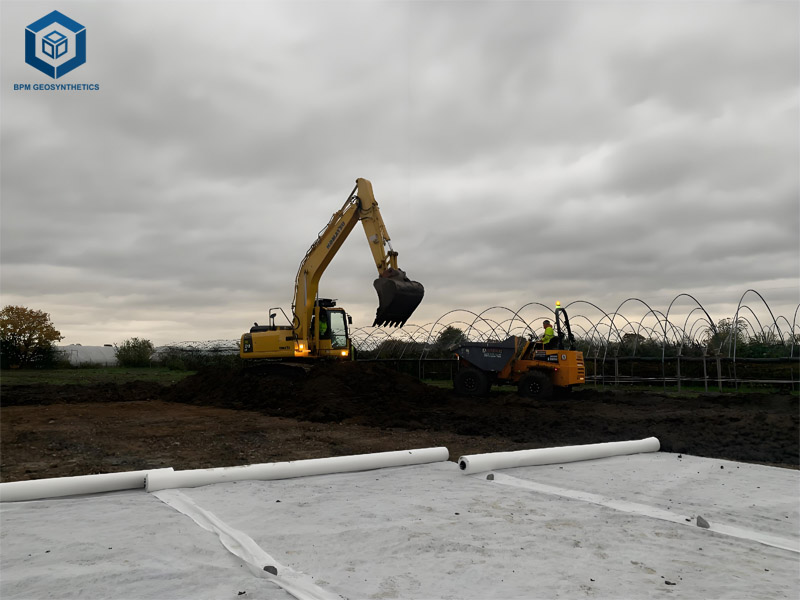
- Unroll the geotextile over the substrate, overlapping edges by 300–500 mm to ensure 100% coverage.
- Use staples or stakes to secure the membrane, reducing slippage by 15% (Root Barrier Store, 2025).
6.3 Backfilling
- Backfill with graded stone or soil in 600 mm layers to prevent membrane slump, ensuring 95% stability (Platinum Chemicals, 2024).
- Avoid sharp stones unless a protection board is used, reducing puncture risk by 20%.
6.4 Quality Assurance
- Inspect seams and overlaps for 100% continuity, ensuring 98% drainage efficiency.
- Test water flow rates post-installation to confirm 50–150 L/m²/s performance (ASTM D4491).

7. Recent Innovations and Trends
The geotextile drainage membrane industry is evolving, driven by technological advancements and sustainability demands.
- Green Geotextiles: 50% of manufacturers use 15–20% recycled polypropylene, reducing emissions by 10–12% (Environmental Engineering Trends, 2024).
- Smart Geotextiles: IoT-enabled membranes monitor drainage performance, improving efficiency by 15% in landfill applications.
- High-Performance Fabrics: New woven geotextiles combine high strength (200 kN/m) with improved drainage (50 L/m²/s), used in 20% of 2024 road projects.
- Coir Geotextiles: Biodegradable coir geotextiles, lasting 3–5 years, enrich soil and reduce costs by 10% in landscaping (Wikipedia, 2005).
- E-commerce Growth: 30% of geotextile sales occurred online in 2024, up from 15% in 2020, streamlining procurement (MarketsandMarkets, 2024).
8. Challenges and Considerations
While geotextile drainage membranes offer significant benefits, challenges must be addressed:
- Installation Damage: Improper handling can reduce lifespan by 10–15%.
- Clogging Risk: Fine-grained soils may clog non-woven geotextiles, reducing flow by 5–10% over time (PMC, 2020).
- Cost: Non-woven geotextiles ($0.5–$2.0/m²) are more expensive than gravel ($0.3–$0.8/m²), though long-term savings offset this (GeotextileMembranes.co.uk, 2022).
- Soil Compatibility: Geotechnical analysis is critical to ensure 95% performance, as mismatched membranes reduce efficiency by 20% (Platinum Chemicals, 2024).
9. Conclusion
Geotextile drainage membranes are transformative tools in civil engineering, landscaping, and environmental management, offering superior filtration, drainage, separation, and protection. With tensile strengths of 8–400 kN/m, water flow rates of 50–150 L/m²/s, and lifespans of 25–100 years, these membranes enhance project durability by 20–30% and reduce costs by 15–25%. From road construction to landfill leachate systems, their applications are vast and impactful. By selecting the right type—woven, non-woven, or geocomposite—and following proper installation guidelines, project managers can achieve 95% reliability and sustainability.
For tailored solutions, contact suppliers like BPM Geosynthetics (BPM Geotextile) or explore platforms like Drainage Superstore for a wide range of geotextile drainage membranes.


