
Geotextiles are critical components in modern construction, environmental engineering, and landscaping projects, offering solutions for soil stabilization, drainage, filtration, and erosion control. As their applications expand across industries, a common question arises: What is the geotextile price per square meter? This in-depth guide explores the pricing dynamics of geotextile fabrics, providing detailed insights into factors influencing costs, current market ranges, and strategies to optimize your budget. Backed by industry data, specifications, and practical examples, this article is designed to help engineers, contractors, and project managers make informed purchasing decisions.
1. Understanding Geotextiles: A Brief Overview
Geotextiles are permeable fabrics, typically made from synthetic polymers such as polypropylene (PP) or polyester (PET), used to enhance soil performance in civil engineering projects. They serve functions like separation, reinforcement, filtration, and drainage, making them essential for applications such as road construction, landfills, and coastal protection. According to MarketsandMarkets, the global geotextile market is expected to grow from $7.1 billion in 2023 to $12.4 billion by 2030, driven by increasing infrastructure development and environmental concerns.
Types of Geotextiles
Geotextiles are categorized based on their manufacturing process and material composition, each affecting their price and suitability:
- Woven Geotextiles: Interlaced PP Geotextile or PET Geotextile threads provide high tensile strength (20–400 kN/m), ideal for reinforcement and separation. Prices range from $0.50 to $3.00 per square meter.
- Non-Woven Geotextiles: Needle-punched Geotextile or thermally bonded fabrics offer high permeability for filtration and drainage, with tensile strengths of 5–50 kN/m and prices from $0.20 to $2.50 per square meter.
- Composite Geotextiles: Combining woven and non-woven properties, these cost $0.75 to $3.50 per square meter and are used in complex projects like landfills.
- Natural Geotextiles (e.g., Jute, Coir): Biodegradable options cost $0.10 to $1.00 per square meter, suitable for temporary erosion control.
Understanding these types is crucial for aligning your project needs with budget constraints.


2. Factors Affecting Geotextile Price Per Square Meter
Geotextile prices typically range from $0.10 to $3.50 per square meter, influenced by multiple factors. Below, we analyze these drivers with industry data and specifications to provide clarity.
2.1 Geotextile Price Per Square Meter – Material Composition
The choice of raw materials significantly impacts cost. Common materials include:
- Polypropylene (PP): Chemically resistant and cost-effective, PP geotextiles start at $0.20/m² for non-woven fabrics and $0.50/m² for woven.
- Polyester (PET): Offers higher tensile strength but is prone to hydrolysis in alkaline soils, costing $0.30–$2.50/m².
- High-Density Polyethylene (HDPE): Used in specialized applications, HDPE geotextiles range from $0.50 to $3.00/m² due to enhanced durability.
- Natural Fibers (Jute, Coir): Eco-friendly but less durable, these cost $0.10–$1.00/m², ideal for short-term projects.
Raw material prices, tied to oil markets, can fluctuate by 5–15% annually, affecting geotextile costs.
2.2 Geotextile Price Per Square Meter – Type of Geotextile
Woven geotextiles, with superior strength, are pricier than non-woven fabrics, which prioritize permeability:
- Woven: $0.50–$3.00/m², used for road stabilization and embankment reinforcement.
- Non-Woven: $0.20–$2.50/m², ideal for drainage and filtration.
- Composite: $0.75–$3.50/m², offering versatility for landfills and drainage systems.
- Knitted: $0.50–$2.00/m², used for flexible applications like soil reinforcement.
2.3 Geotextile Price Per Square Meter – Weight and Thickness
Geotextile weight, measured in grams per square meter (GSM), and thickness (0.5–5 mm) correlate with cost due to material usage:
- Lightweight (80–150 GSM, 0.5–1 mm): $0.10–$0.80/m², used for landscaping or weed barriers.
- Medium-Weight (150–400 GSM, 1–3 mm): $0.50–$1.50/m², suitable for erosion control and drainage.
- Heavyweight (400–800 GSM, 3–5 mm): $1.00–$2.50/m², used for landfill liners or road stabilization.
Higher GSM fabrics are 10–20% costlier but offer greater durability.
2.4 Geotextile Price Per Square Meter – Manufacturing Processes and Treatments
Production techniques and enhancements add to costs:
- UV Stabilization: Increases lifespan by 10–20 years in exposed applications, adding 5–10% to costs.
- Chemical Resistance: Coatings for acidic or alkaline environments raise prices by 10–15%.
- Needle-Punching vs. Thermal Bonding: Needle-punched non-woven geotextiles ($0.20–$1.50/m²) are cheaper than thermally bonded ($0.50–$2.50/m²).
2.5 Geotextile Price Per Square Meter – Roll Size and Dimensions
Standard rolls (1.5–6 m wide, 50–100 m long) are cost-effective, while custom sizes increase prices by 10–20% due to additional processing. For example, a 4.5m x 100m non-woven roll costs $0.40/m², while a 2m x 50m roll may cost $0.50/m².
2.6 Geotextile Price Per Square Meter – Purchase Volume
Bulk orders reduce costs by 10–30%. For instance, purchasing 10,000 m² may lower the price from $1.00/m² to $0.80/m². Minimum order quantities (MOQs) typically start at 1,000 m² for wholesale discounts.
2.7 Geotextile Price Per Square Meter – Market Conditions and Location
Regional factors influence pricing:
- North America: $0.50–$3.00/m², driven by higher labor and regulatory costs.
- Asia-Pacific: $0.20–$2.00/m², benefiting from lower production costs in China and India.
- Europe: $0.40–$2.50/m², impacted by environmental standards and import duties.
Supply chain disruptions or currency fluctuations can cause 5–10% price variations.
2.8 Geotextile Price Per Square Meter – Supplier and Brand Reputation
Premium brands like TenCate, Solmax, or Mirafi charge 5–15% more due to quality certifications (e.g., ASTM D4632, AASHTO M288). For example, Mirafi 160N costs $0.80–$1.20/m², while generic non-woven fabrics may cost $0.50/m². Local suppliers may offer lower prices but lack certifications.
3. Current Market Price Ranges for Geotextiles
Below is a detailed breakdown of geotextile prices per square meter, based on recent market data:
| Geotextile Type | Weight (GSM) | Price Range ($/m²) | Typical Applications |
| Woven PP | 100–400 | 0.50–3.00 | Road stabilization, reinforcement |
| Non-Woven PP | 100–800 | 0.20–2.50 | Drainage, filtration |
| Non-Woven PET | 150–600 | 0.30–2.50 | Landscaping, erosion control |
| Composite | 200–600 | 0.75–3.50 | Landfills, drainage systems |
| Natural (Jute, Coir) | 200–500 | 0.10–1.00 | Temporary erosion control |
Regional Variations:
- United States: Non-woven: $0.50–$2.50/m²; Woven: $0.75–$3.00/m².
- India: ₹10–₹80/m² ($0.12–$0.96/m²), driven by local production.
- China: $0.20–$2.00/m², competitive due to scale.
- Malaysia: $0.30–$2.50/m², influenced by logistics costs.
Note: Prices are indicative and may vary based on supplier, order volume, and market conditions.
4. Additional Costs Associated with Geotextiles
Beyond material costs, several expenses impact the total project budget:
Installation Costs
Installation accounts for 30–50% of total costs, ranging from $0.50 to $2.00 per square meter:
- Site Preparation: Clearing debris and grading add $0.20–$0.50/m².
- Labor: Skilled labor costs $0.30–$1.00/m², higher in urban areas (e.g., $1.50/m² in New York vs. $0.80/m² in rural areas).
- Equipment: Compactors and excavators add $0.10–$0.50/m² for large projects.
Proper installation, with 300–600 mm overlaps and secure anchoring, reduces long-term repair costs by 15%.
Transportation and Logistics
Shipping costs depend on distance and order size. International sea freight adds $0.05–$0.20/m², while local delivery costs $0.01–$0.05/m². Bulk orders minimize per-unit shipping expenses.
Accessories
Securing materials like landscape staples ($0.01–$0.03 each) or geotextile pegs ($0.05–$0.10 each) are necessary, adding $0.05–$0.15/m² for large projects.
Maintenance and Repairs
Geotextiles require minimal maintenance, but repairs for tears or clogging cost $0.10–$0.50/m². Regular inspections, per ISO 13437, reduce long-term expenses by 10–20%.
5. How to Optimize Geotextile Costs
To balance quality and affordability, consider these strategies:
Select the Appropriate Geotextile Type
Match the geotextile to your project’s needs to avoid over-specification:
- Drainage/Filtration: Lightweight non-woven PP (100–200 GSM, $0.20–$0.80/m²).
- Reinforcement: Woven PP (200–400 GSM, $0.50–$2.00/m²).
- Erosion Control: Natural geotextiles ($0.10–$1.00/m²) for temporary applications.
Refer to standards like ASTM D4632 or AASHTO M288 for guidance.
Source from Reputable Suppliers
Engage with trusted manufacturers like BPM Geosynthetics, Solmax, or TenCate for certified products and competitive pricing. Compare quotes from multiple suppliers to secure the best deal.
Purchase in Bulk
Ordering large quantities (e.g., 10,000 m²) can reduce costs by 10–30%. Negotiate volume discounts or explore seasonal promotions.
Optimize Installation
- Subgrade Preparation: Ensure a smooth, debris-free subgrade to prevent punctures, saving 5–10% on repairs.
- Minimize Waste: Use standard roll sizes to reduce cutting, lowering material costs by 5–10%.
- Hire Skilled Labor: Certified installers ensure proper overlaps and anchoring, extending lifespan by 10–20%.
Focus on Long-Term Value
High-quality geotextiles with UV stabilization or chemical resistance may cost 10–15% more but last 20–50 years, reducing replacement costs. For example, PP non-woven geotextiles in buried applications can last up to 200 years.

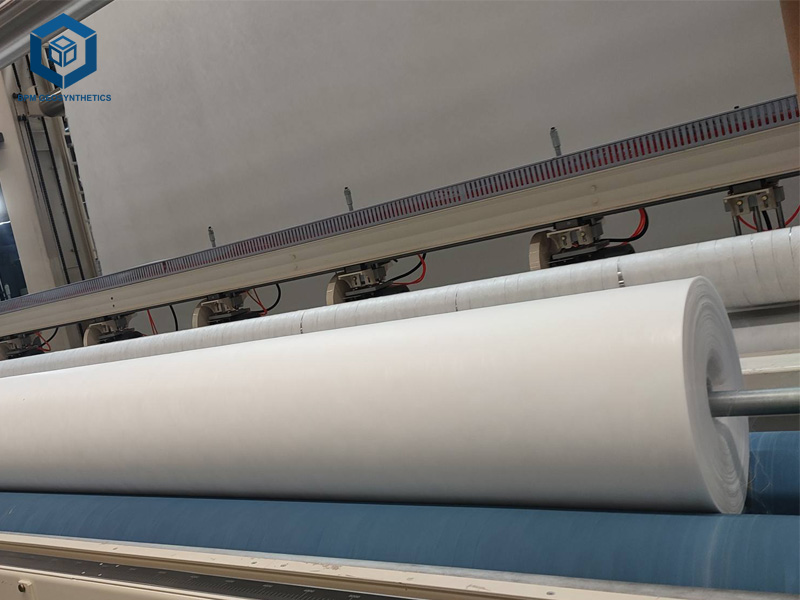
6. Real-World Applications and Cost Examples
Geotextiles are used in diverse projects, each with unique cost profiles. Below are practical examples:
Road Stabilization
- Application: Woven PP geotextiles (200 GSM, $0.75/m²) prevent aggregate loss in road bases.
- Cost Example: A 10,000 m² highway project requires $7,500 for materials, $5,000 for installation, and $1,000 for logistics, totaling $13,500.
- Savings: Geotextiles reduce maintenance costs by 20–30% over 20 years.
Landfill Drainage
- Application: Heavyweight non-woven PP geotextiles (400 GSM, $1.50/m²) provide filtration and puncture protection.
- Cost Example: A 50,000 m² landfill requires $75,000 for materials, $25,000 for installation, and $5,000 for accessories, totaling $105,000.
- Savings: Extends liner lifespan by 15–20 years, saving $50,000 in replacements.
Erosion Control
- Application: Jute geotextiles (300 GSM, $0.50/m²) stabilize slopes temporarily.
- Cost Example: A 5,000 m² coastal project costs $2,500 for materials, $1,500 for installation, and $500 for pegs, totaling $4,500.
- Savings: Biodegradable geotextiles eliminate removal costs, saving $1,000.
7. Conclusion
Geotextile prices per square meter range from $0.10 to $3.50, driven by material composition, type, weight, manufacturing processes, purchase volume, market conditions, and supplier reputation. Woven geotextiles ($0.50–$3.00/m²) excel in reinforcement, while non-woven ($0.20–$2.50/m²) are ideal for drainage and filtration. Additional costs like installation ($0.50–$2.00/m²) and logistics ($0.05–$0.20/m²) must be considered for accurate budgeting.
To optimize costs, select the appropriate geotextile type, source from reputable suppliers like BPM Geosynthetics, buy in bulk, and ensure proper installation. High-quality geotextiles offer long-term savings through durability, with lifespans up to 200 years in buried applications. For precise pricing, request quotes from multiple suppliers and verify certifications like ASTM D4632 or AASHTO M288.
By leveraging these insights, you can achieve cost-effective, sustainable solutions for your construction or environmental projects. Contact BPM Geotextile for tailored guidance and competitive pricing to ensure project success.


